Claiming a Table

I like getting to the coffee house before the regular bunch arrives. Not because I mind them. Once I have my AirPods in, the room could be full of marching bands and I’d still be able to work, most days. But I do like to get there early enough to claim a table.

Today I wasn’t early enough. Or I thought I wasn’t. There were only front-window stools available. Being a shortie, I wasn’t keen on them, but I was willing to try hoisting myself onto one. 

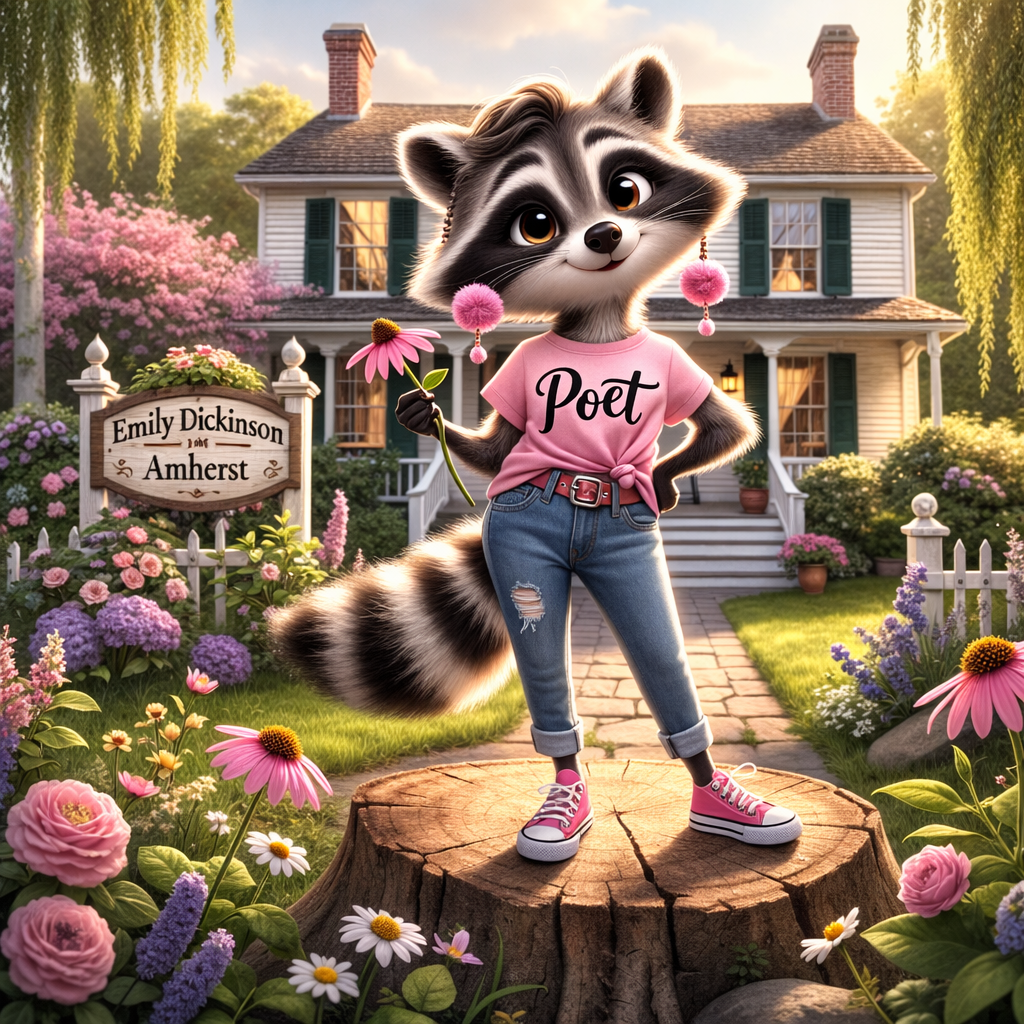
Everything feels off today anyway: I had to park down the block. (Joke’s on the parking trolls – I am traveling light today.) And it’s going to be warmer today (yay!) so Word Raccoon insisted on digging through her dresses to find the one that doesn’t know if it’s a dress or a blouse but she said we were going to wear leggings so who cared which it wanted to be? 

And oh dear, she also demanded I wear my gold chain belt.

I rarely wear belts. But seeing the dress/blouse on, I agreed with her. (I think she’s actually auditioning the outfit to see how it will work for tonight’s outing.)

Also, she has major bedhead curls and when I went to tame them she snapped at me. So, fine, here we are. 

Like I said, different. 

My laptop and purse were already at the window counter and I was greeting some regulars when WR spotted the barista cleaning a table. WR didn’t ask, she didn’t look around to see if anyone was waiting on it (shameless animal). She grabbed that table. 

In my mind, she is offering to share it if needed. But will she?  She thinks writers are like cats and must establish a place before they can think properly. She also believes that if we get there early enough we deserve a spot, which is not strictly true but I usually go along with her.

There’s a difference between choosing a place to sit and taking whatever happens to be left. When I get there early, I can pick the table that feels right, set down my things, and settle in before the day fills up. By the time the room gets busy, I’m already working. It feels less like I’m squeezing writing into my life and more like writing has a place to sit.

Sometimes I know exactly what I’m going to work on, and sometimes I don’t. Often I arrive with only a vague idea and open a draft just to see what happens. Writing doesn’t always begin with inspiration. A lot of days it starts with showing up somewhere and putting your laptop on the table.

I didn’t manage to beat the “breakfast club” here today. (Don’t tell them WR calls them that, but it’s a group of lovely people whose combined laughter decibels could shatter glass. WR is reaching for the AirPods.)

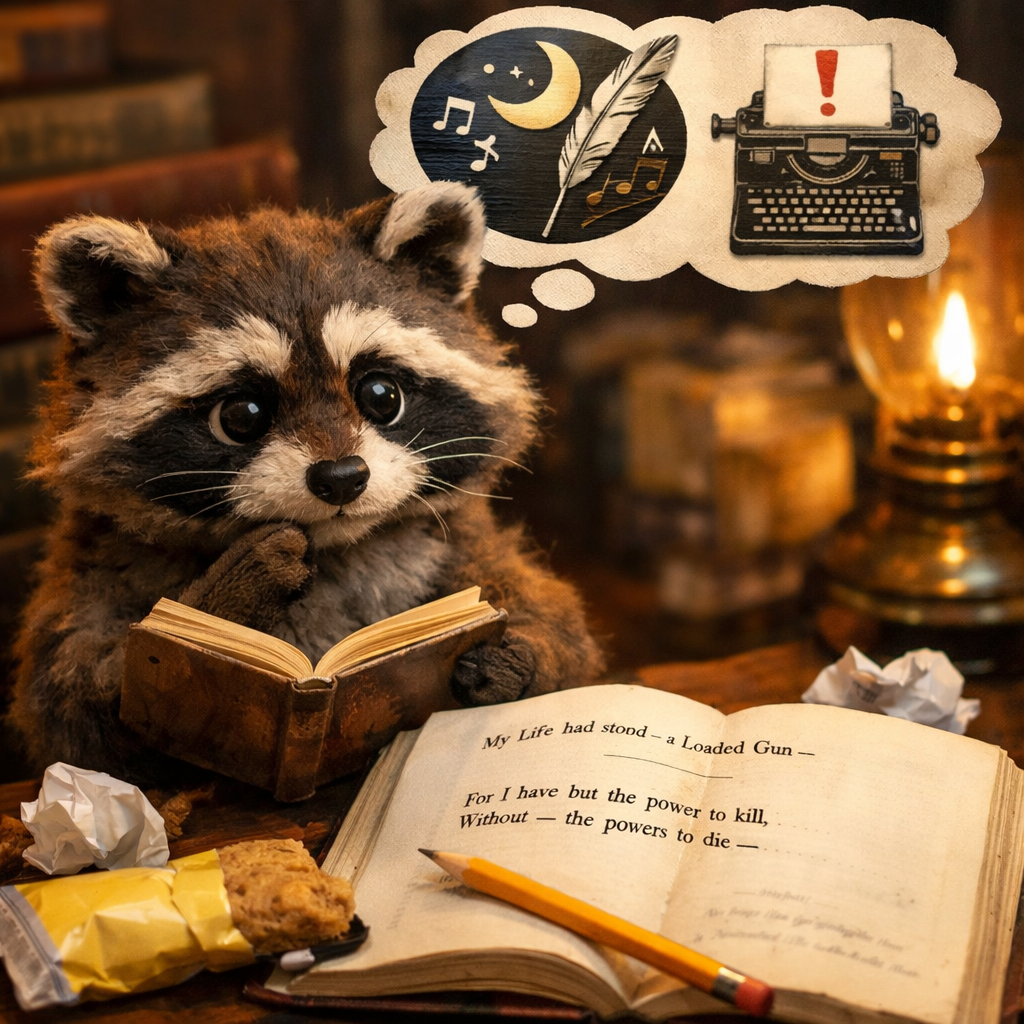
I asked WR what we are working on today, and she says she wants to revise some poetry. Good choice. Though I know she has been a bit intimidated by our Emily Dickinson studies. 

She denies this hotly, but I know…

As always, we will see what happens with the words. 

P.S. Books still seem to come to me in clusters. The library texted me  Departure(s) by Julian Barnes and Vigil by George Saunders were ready for me only a day apart, and I’m still reading The Weight of Ink, which I love but can’t really read in bed because it’s too heavy. So lately I’ve been bouncing between Barnes and The Weight of Ink, as if they’re competing for my attention, while Saunders waits patiently for his turn. 

Ironically, Barnes is talking about Proust and the nature of memory in his slim book, and I feel like some of our thoughts overlap. 
Word Raccoon Does the Taxes

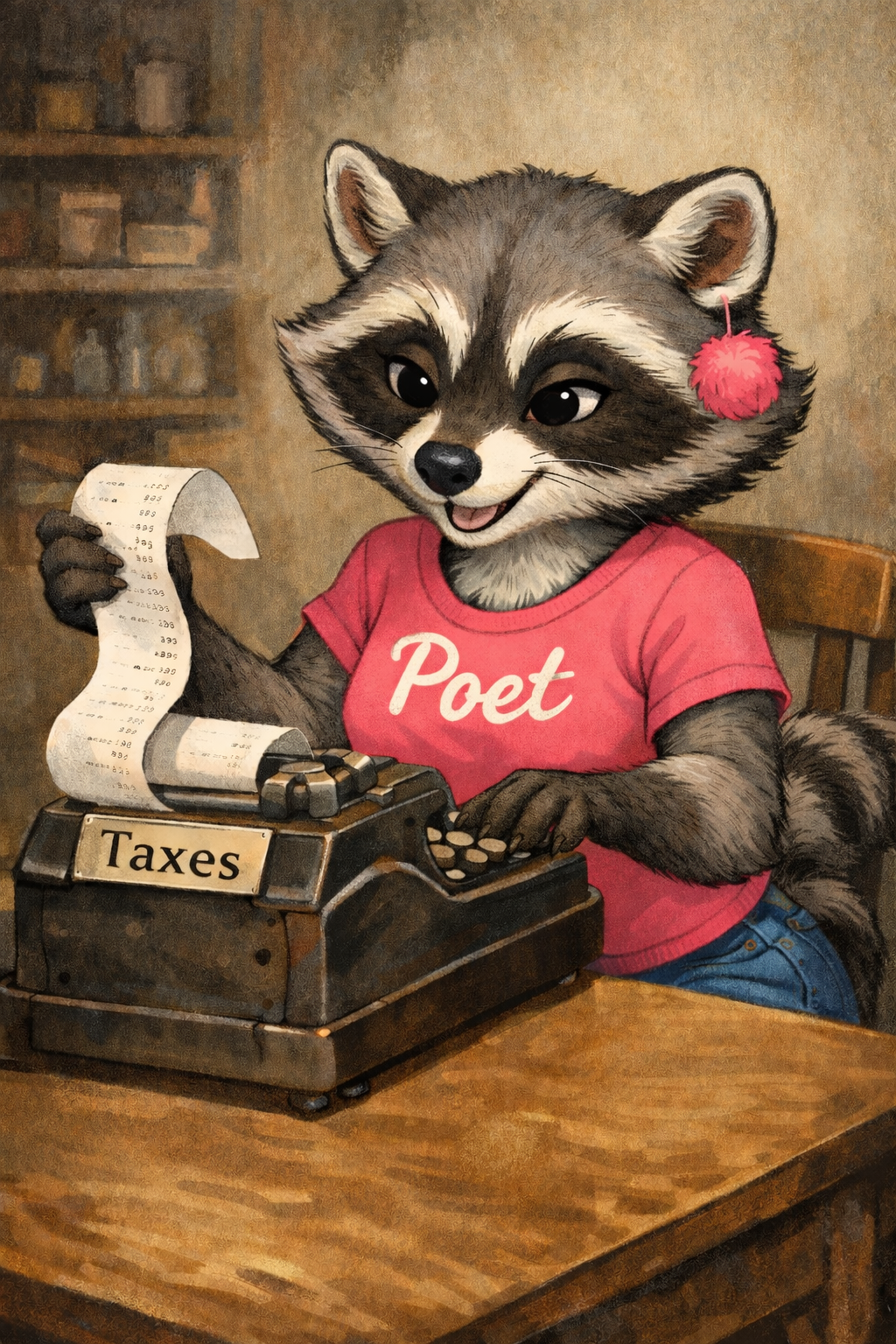
Word Raccoon and I are doing taxes. Writerly taxes.

We do not particularly enjoy this, but we know it is necessary. I have a method. Word Raccoon, meanwhile, insists on buying books behind my back and believes we ought to get deductions for squirrel food. I told her I really don’t think the IRS will go for that.

Ah, yes, the yearly gathering of expenses. Every January I start a note in my phone labeled with the year, and as writerly expenses come along, I add them. When I remember.

Office supplies. Memberships. Software. The Authors Guild.

Just like any other small enterprise, I suppose. You have to keep track of subscriptions, travel, and those borderline things you’re not sure you want the hassle of claiming. Being conservative always feels safer.

There’s the Amazon account to check, to see what books Word Raccoon did indeed order.

There’s the mental inventory:

Website fees.
Podcast fees.
Microsoft Word.
Submissions.
Supplies.

And of course the bank account to scour, in case something slipped through the cracks.

What I didn’t expect this year was that my expenses would tell a story.

Looking through the list, I realized how much my writing life has shifted.

There were far fewer tech and course expenses this year. Fewer subscriptions. Fewer attempts to systematize or professionalize myself into some imagined efficiency.

But there were so many poetry submission fees. Contest entries. Journal submissions. Lines and lines of them.

No one likes the fees. But in years of yore, when I was sending out short stories and the like, you had to print the story, put it in an envelope, include a SASE. Nowadays the submission fees pretty much pay for themselves in the hassle they save by allowing you to submit online.

And there’s the bonus of helping journals and contests stay alive, able to cover their expenses and pay writers.

So I’m not complaining about the fees.

I’m just noticing.

And I’m noticing, based on tracking them, what I’ve been writing that I’m submitting.

Poems.

So many poems.

I didn’t set out to reorganize my writing life in 2025. I started writing poems in April because something in me needed a place to go. There were things I didn’t know how to carry any longer in prose. 

Poetry turned out to be a smaller door that opened into a larger room.

Soul saving with a side of admin: now there’s a whole record-keeping system where none existed before.

Submission trackers.
Draft folders.
Reading lists.
Journals I follow.
Contests I know by name.
Deadlines that appear on the horizon like weather.

A year ago? None of this.

And now the proof of it is sitting in a column of numbers.

Lines of submission fees.

Small charges that look almost insignificant until you see them gathered together, evidence of a whole new life forming in quiet increments. (Let’s not talk about the total!)

What astonishes and tickles me is that the place this transformation shows up undeniably is my taxes.

In my taxes.

Word Raccoon finds this hilarious, of course. She is convinced the IRS should issue creative-progress reports along with refunds. IDK about that, WR.

Poetry brought Word Raccoon to me, gave me a voice to say the unsayable. Freed me of the “shoulds” and so many, many, “shouldn’ts.”

Poetry gave me a place to put pain and joy and ordinary days that might otherwise have passed without being marked. It gave me a way to process things I didn’t know what to do with. It gave me new work and new excitement.

New craft tools to play with.

And apparently it gave me new deductions.

This reminds me of looking through censuses for ancestors and finding something unexpected, like they were an artist when you thought they were a teacher.

The most extraordinary things in a common bureaucratic document.

But there it is.

A quiet record of the year poetry moved in and rearranged the furniture.

Word Raccoon wants to say something funny or dramatic here, but I’m putting my finger on her lips, just for now. 

Just for now. 

Notes on Dickinson from the Bunker of Peevishness 

In the 90’s, I studied with a professor who was of the New Critics school. He stressed that we should not focus on an author’s biography. We were to focus almost solely on the work. 

As the granddaughter of a poet who had dubbed himself “The Coal Miner Poet,” that didn’t sit right with me. (His biography was in his title! And can we just appreciate the badassery of giving yourself a title?) 

I thought about my two uncles who wrote poetry, too. Knowing their stories enriched their work for me. 

Ditto any author. While I don’t need to know everything about an author’s background, I was delighted to learn that, for instance, Louisa Alcott had three sisters and drew heavily on her life at Orchard House. 

(And psst…ironically, Dickinson is exactly the kind of poet the New Critics loved, because her poems almost demand close reading without biography.) That being said, my study of Dickinson is being frustrated right now by the intense focus of others on her life’s story. 

While I, like many others, I suspect, was fascinated to hear that Taylor Swift is a distant relation of Dickinson’s, and I was quick to put together Dickinson’s chrysolite from her “There Is a World By Men Unseen” and compare it to Swift’s “Opalite,” a comparison I’m not at all sure was purposeful on Swift’s part but is fun to play with (the song’s controversy aside, of course), I have been frustrated by my efforts to find actual discussions of Dickinson’s poetry.

I have not looked for written discussions and criticism yet. I have been focusing on videos and podcasts for now, just so I could listen or watch while I do other things. (Laundry abhors silence.)

I mentioned Adam Walker’s wonderful lectures on Youtube, and John Green’s excellent yet mere blink of a video on her. Today I discovered Wobbly Bits, videos from 2015 that appear to be the filming of what might be an MFA-style workshop discussion of her poems. All of these videos I have found helpful, especially the latter. Listening to multiple takes on a poem helps. 

But so many others go on and on about the salacious behavior of those around Dickinson and what is merely speculative about her. 

Are they interested in her work, or her biography? 

Do they want to know what she means when she speaks of telling the truth in a poem, or do they want to talk about how she supposedly only wore white? (I haven’t tracked the truth down about white, as I have heard arguments both ways and I really don’t give a good goddamn.) 

Is it because she’s a woman that they focus on what are admittedly (sometimes) intriguing details about her life? 

If her work were weaker, I would be more tempted to care whether she loved men or women. If she ever left her house. 

Are they afraid to dive into her difficult poems? Are they afraid to admit that even when her poems appear transparent, they are (oh, here I go) chrysolite, maybe even opalite? 

Listen, Linda (see internet circa 2015 for the reference), what I am discovering is the almost futility in imagining I will be able to fully understand any of her poems. But I’m trying. I’m enjoying the atmosphere, the weather of them.

As I said yesterday, I can get the “guh-guh” feeling of them (see Dirty Dancing for that reference, the scene where Swayze gets through to Grey about how to feel dancing). 

But if I listen to one more podcast or watch one more YouTube video where they focus on her goddamn flowers…

Fine, her love of flowers, her knowledge of them, says a lot about her. 

But her poems are flowers that have never grown anywhere else. Never will. 

Why are we looking at her flowers, besties? 

HAVE YOU READ HER POEMS?

This post was sponsored by Word Raccoon and fueled by inferior library tea, the beverage of frustrated poets and their writing sidekicks. 

Salud! 

Narrative Vs. Lyric Logic (Word Raccoon has Feelings about Both)

Word Raccoon and I are still reading Emily Dickinson. Not according to plan, no, no, of course not, because my puppet of chaos could not allow that, but we are reading.

Yesterday I caught myself rereading the end of “My Life had stood – a Loaded Gun –,” which, if you’re familiar with the poem, ends with a paradox that refuses to smooth its hair.

And if you’re not familiar with it, I recommend this power-packed poem.

The “power” in the poem is tangled with dependence and agency. The tension holds at the end like I hold onto the handle of the rare roller coaster ride I allow myself. (Word Raccoon would go on more roller coasters if I’d allow it.) It’s quite the ride. 

My novelist brain says about the poem at its end: Close the damn scene. Take the shot. 

To novelists, a scene must justify its existence. Even if the ending is ambiguous, it is shaped ambiguity. Something has shifted. A door closes. A line lands. Action has occurred or is implied.

In fiction, you do not (usually; exceptions to every rule and all that) get to simply intensify and walk away. You don’t toss a match and hope something blazes. The reader must feel the emotional circuit complete.

Dickinson does…something different.

She cranks up the volume and then leaves the room with her middle finger raised without looking behind her.

The poem does not close like a scene. It reverberates like a song on repeat.

Word Raccoon, who prefers either a tidy ending or a dramatic explosion (because of course she does), would like to know where the rest of the story went in the poem.

Dickinson shrugs, which is kinda maddening and kinda brilliant.

CRAFT NOTE INCOMING, THOUGH NOT CAREFULLY EXPLORED:

Narrative logic asks: What happens next? What does this mean for the characters?

Lyric logic asks: What is the exact texture of this moment? What will destabilize the reader enough to make them return to the poem? 

Dickinson is not trying to finish a story. She’s allowing the tangle in the curl to remain, knowing if she combs it, the tangle leaves but so does the curl. (Ask me how I know.) 

The person in the poem (she used many personae; let’s not assume she always meant herself) has to grapple with agency and dependence, no small things. Whether we read this as poet and muse, woman and her relationship to a man, or so on, none of these scenarios are easily resolved. Asking her to do so by the poem’s end is asking her to tidy life. 

We all know that’s no easy task. 

If this were a casual essay, that would be the end of my post. But as Word Raccoon has pivoted from my structured Dickinson study plan (naturally) into poetry-as-she-pleases with tasty snacks, I will allow myself a pivot as well.

When I stand before a painting I do not fully understand, I might admire the color, the composition, the boldness of the gesture, the way a painter defies expectation. I do not demand that every brushstroke translate itself into a thesis statement.

(Usually. Unless I feel like the artist is trying to say something and I’m missing it. But in general, I have learned to relax and enjoy art without having to study it for meaning.)

I might even, gasp, just enjoy the beauty of a pink stripe or a buzz of sunlight. 

But when I read a poem or a novel, anything, I expect total comprehension.

Line by line.
Word by word.
Punctuation mark by punctuation mark.

If I cannot explain it, I feel I have failed.

I know that’s expecting a lot of myself. I know that’s impossible. Even if I look up a word I don’t know, sometimes that’s not enough because the usage is archaic or feels misplaced or, you know, poets take that thing called poetic license.

Sometimes it’s the feeling the poet wants for us, not total comprehension. Maybe they are gesturing to the incomprehensible. 

Sometimes they are purposely obfuscating. 

When I was a child, there were moments when the older women at family gatherings: my aunties, my mom, my grandma, etc., told stories I don’t think I was always supposed to understand. 

Often, if I stayed quiet and out of sight, they seemed to forget I was there and would say the things that would then make sense of something I had only half comprehended until then.

Or that would make me ask a question that would quiet the car on the ride home. 

If I made any sound or made myself too visible, my grandmother would tell me to “run off and play,” which maddened me. I wanted to hear the stories, even the ones about the aunt who had surgery and the gruesome aftereffects. 

I also delighted in just listening to my relatives’ rich Southern voices, something I was still keenly aware of because our family had recently moved to West Virginia from New Jersey. (My parents had been born in WV and were returning there; I had been born while they lived in NJ.) 

When I did go outside to where my dad and the other men were, their stories were often about work: the guy who brought six boiled eggs every day for lunch, coal mine cave-ins and who had gone on disability as a result, a joke about the best way to patch a henhouse. Those tales were just as captivating, but these also relied on translation. I knew not to ask questions, not there, to once again be quiet and listen.

Especially when I could tell that the nervous laughter around “henhouse” meant I was missing something they were afraid I had picked up on.

So when Dickinson compresses meaning and leaves it partially veiled, I want her to say it plainly. I want the sentence to behave like a sentence and not a riddle. Word Raccoon would like to file a formal complaint with the Department of Declarative Statements against some poets.

But perhaps the tangle is not evasion. Perhaps it is, as I said above, honesty.

Truth be told, I like a literary challenge. I just want to feel that if I keep trying, success is possible. Cracking literary code is my quest movie. To say there is no code is to take away my joy in literature.

That’s probably a shortcoming. 

WR is swinging from a curtain rod, nodding and nibbling on a lemon Luna bar. 

A novelist closes scenes because narrative demands movement and consequence. A poet may leave the door open because experience itself is unresolved and/or unresolvable.

Dickinson is not careless. She is precise in her refusal to simplify. Even WR admits that.

And maybe part of my own education as a poet is learning when not to close the scene.

To let the voltage remain.

To trust that a reader can stand in the room without the lights being fully explained.

Word Raccoon is unconvinced, but she is willing to consider it. For now.

If her poem from yesterday is any indication, she may even be embracing it. 

When I Swatted at a Fly Instead of Listening to It 

I have an embarrassing admission about my initial thoughts on Emily Dickinson.

I first studied her in junior high. I noticed her odd capitalization and strange punctuation. The willy nilly italics. I assumed she didn’t know better, and I kinda pitied her. (*Buries face in hands.*)

I found her work impenetrable. Almost morbid. I remember the illustration for “I Died for Beauty” in our literature book, tombstones slowly swallowed by moss. It all felt heavy for fifth period, the one just after lunch.

The way I came to these conclusions are both understandable (I hope) and embarrassing as well. 

At home we had a souvenir copy of the Declaration of Independence with its long s characters that looked like f’s and capital letters scattered wherever they pleased. I knew spelling used to vary, because it irritated me to see words spelled multiple ways when I read older documents. I knew conventions were loose once upon a time.

I even knew a bit about the dictionary wars, though we weren’t yet calling it that. Or I think I did. 

So my young mind stitched those facts together and decided Dickinson’s poems were simply another example of quirky spelling, playful caps. Bless her heart, intended in the most Southern of ways. 

I don’t need to tell you, Dear Reader, just how wrong I was. I repent. Utterly. 

Over the past few days I have spent serious time with Ms. Emily Dickinson in my quest to study poetry. On Friday morning I began what I am calling an in-depth look.

Word Raccoon believes that means reading all eighteen hundred of her poems, watching every lecture, and consuming every article ever written on Dickinson. I believe it means watching her craft. Studying her choices. Trying to see how she sees.

Along the way I found Adam Walker’s thoughtful videos on poetry, especially his discussions of Dickinson. He wears round glasses and has a boyish face. Word Raccoon insists the Harry Potter comparison is inevitable. However, we both enjoyed the videos immensely.

What did you do this weekend, Drema? I watched YouTube videos about Emily Dickinson.

Call it boring if you like. I call it mind expanding.

On Friday morning I spent half an hour reading and rereading “I Heard a Fly Buzz.” I listened for sound. I tracked the rhythm. The silence. 

I also wrote a poem. I watched the women at a nearby table and noticed how their gestures rose and fell. I wondered how long it takes for a movement to lose its starch. Reading Dickinson sharpened my noticing, I’d like to think. 

At one point a woman entered the cafe wearing earrings like a pair I own, a bold statement shirt, and a colorful crocheted clutch. One striking detail invites conversation. Two might. Three feels iffy. Or maybe it was simply the closed expression on her face. I will risk a hello, but only when it feels safe.

Back to the “Fly.” As many times as I read the poem, it did not fully yield. That is part of the work: you have to catch a poet’s rhythm. You have to listen the way they listen. Sound mattered deeply to her, and I am realizing how much I rely on image and idea, and how much more attention I want to give, should give, to sound.

This week I will continue. I will read carefully. I will consult supplementary materials without disappearing down rabbit holes. I do have other obligations. Work is work. Poetry is the good stuff.

I could share my notes on the poem here, but I suspect they contain both the obvious and what I have somehow missed. That is the humbling part of study, and I don’t think I’m that brave.

What I can say is this: I am enjoying it. Her language is fearless and exact. It sparks thought after thought. It makes me want to be braver and more precise. I am jealous of her abilities, but I am also grateful that her poems exist.

I hope to share specifics at some point. Then again, WR may have other ideas.

P.S. I have also begun rereading The Weight of Ink by Rachel Kadish. I was tired of screens and wandered the house until that book called to me. It is heavy in the hands, over five hundred pages. This time, remembering that the readers I admire most read slowly, I am moving through it with intention. It’s gorgeous, and it’s the perfect book for winter’s end. 

Or am I getting ahead of myself again? 

Revisions and Dickinson 

I revised ten poems yesterday. Word Raccoon mostly kept her nose out of things while I did, spinning on her pink throne cuddling with her stuffy, Book Goblin.

Ten poems.

By the end, my brain said no more.

Two are still a bit wooly, but those ten were close enough to be shuttled to the ready-to-submit folder.

The most innocent looking one caused me to rethink my writing choices for the day, but I got back on track after wanting to eat all of the chocolate in the vicinity. 

(That was WR who wanted to do that. I cannot eat as much as I used to due to this arthritis medication. I’m grateful to be able to do most things again. But could I please retain some appetite?)

WR reminds me she still has inconvenient hunger flares on occasion.

The close revision work I did was aided by my new less heat, more precision rubric. I am sure I will refine that later, but the poems are stronger for it, and that is not nothing. 

I cut lines that explained instead of trusting the image. I trimmed heat that was loud but not exact.

A couple of the poems were promoted from micro poems to full with a few additions. I asked a couple of others what they were doing wearing too-large high heels and jagged lipstick. In the end, I was mostly happy with the revisions.  

WR got a bit of her own back for being banished from the revision work yesterday: she talked me into going to the gym between the rain drops, promising we could get a Coke Zero after. Once I was at the gym, I remembered we were not planning on going at all.

She giggled and pedaled away on the stationary bike.

The joke’s on her, more structure is coming her way, and she does not enjoy structure. I have created an independent study of poetry for myself for the next three months, focusing on women in poetry.

Deep dives become core, in my experience. I’m irrationally excited. 

I’m beginning with Emily Dickinson.

Here’s the mucky structure stuff that WR will ignore but I feel better having in place. 


Weeks 1 through 3

Structure
Two sessions per week

Session A
Context
Read letters or a short scholarly essay on Dickinson with focus on theology, syntax, or metaphysics.

Key conceptual moves
Recurring concerns/preoccupations
Philosophical/religious tensions

Session B
Close Reading
Read the week’s poems slowly, twice each. (Ha! As if we will stop at twice.)
Annotate
Verbs
Pronouns
Structural pivots
Where image becomes idea

Restraint 

Write on one of those.

Week 1
Compression/Metaphysical “Risk”

Poem Cluster to Dissect (Not new to me, but worth revisiting.)

I heard a Fly buzz when I died
Because I could not stop for Death
My Life had stood a Loaded Gun
Tell all the truth but tell it slant

I watched some YouTube lectures on her yesterday, including a short entertaining one by John Green. The videos have already shifted my viewpoint on Emily. Is she punny? A bit naughty? The imagery in “Come Slowly” is…evocative. 

Ok, queen. I salute you.

And the I/eye play in other poems. Clever.

I already admire her microscopic attention to flora. I can’t wait to stand face to face with her via her poems and see what conversations we have. 

Show me how you see, I will say as I read closely. (Is there a word for closer than close?) I want to trace her word choices, follow her line breaks, discover her preoccupations.

Not so I can imitate her, but so I can add a lens to my writing. 

Intoxicating.

WR is humming with anticipation, wanting to read essays about her and watch videos! She may not like structure, but she enjoys learning, hearing what others think. 

Or maybe that’s the shot of espresso in my Diet Coke. (WR wants to ask if they will please, please, stock Coke Zero.) 

In the meantime, I just ran into a friend here at the cafe that I haven’t had a sit-down with for a while, and she and I have made plans to remedy that. 

See, WR, it does pay to get out of the house sometimes, even on gray days. 

Anemic Drafts and Other Casualties, Accompanied by Cake

I am in the revision palace. 

I’m wading through the “poems in progress” folder and I’m mercilessly picking and plucking and painting and it’s raining 

and I don’t care even though earlier it felt like the sky was trying to split the earth in two (although “into” would be more interesting to riff on there, if this were a poem. It’s not.)

I am happily lost in the mind forest; I am between fair-fried “tornados” in the teeth and yellow bead necklaces.

Lady Mary and her mother drag a body in a poem along with the show’s iconic line “What is a Weekend?”  

I have a list.

I was up early.

Lists be damned.

I am blaring Cake. 

I will do all of the must-do’s, but not now.

I am outwitting the storms. 

I am outwitting anemic drafts.

I am dangerously deleting the early efforts to keep them from contaminating.

I am writing the words. 

I am warm enough for it, not overheated. 

Word Raccoon wants some tea. Some water, please. She is not even asking for Coke Zero, though she’s had a bit of that. She’s fine. 

All in good time, raccoon, but not now. 

Go play with your toys. Go sit in your pink chair. 

Let the adult do the writing today.

Less Heat, More Precision

Herbert was at it again before dawn, that old curmudgeon who tries to live rent free in my head and critiques everything I write. (He never likes any of my poems.)

Stanley, my scheduler, stepped between us and told me to go to the gym before Word Raccoon got involved. We rowed, and I came home less frantic and ready for porch writing, even if it started out overcast and chilly.

Now the sun beams like it’s proud of itself except when it shyly hides. The trees are in gentle evermotion, and small red buds burst from the branches. 

A squirrel squeaks nearby. Perhaps the birbs will join us, too, sometime? 

(Purple prose? Perhaps. I’m too happy to care. My eyes are full again.)

You need a True North for knowing how to revise your writing. Not someone whose work you imitate (that’s the anxiety of influence; see Harold Bloom) but a lens that quietly recalibrates your own. If you drift too far into the maze, just asking yourself what they would notice brings you back, not to their voice, but to a sharper version of yours.

Lately I’ve been trying to name and interrogate that lens that I know betters my writing as I see it:

Less heat. More precision.

When I manage it, I see the maturity in it. The elegance. The small diamond resting on black velvet. A frame that highlights instead of overwhelms.

But then Word Raccoon starts tossing the pillows off the sofa and pulling out her markers. She wants pastels. Glitter. She wants to gather all the violets in the yard and gather them into a tiny pink perfume bottle.

She doesn’t know if she’s supposed to be embarrassed by her sparkle, or if that sparkle is simply part of her ecosystem. Nature does not apologize for being garish. Gemstones. Tropical fish. Flowers. Who is going to tell nature to give it a rest? Not me. 

I am, for better or worse, a poet now. I feel in Hollywood-sign sized letters and I sometimes write the same. 

I suspect Herbert and WR had a scuffle behind my back because where is her other earring?

I regret nothing.

And still, I admire the diamond. I admire restraint. I admire the clarity of it. 

But what of “Less heat. More precision?” 

Just how much heat can precision hold without burning the reader, and how much precision can heat handle without warping? 

That’s what I aim to find out. It may mean looking at some bent poems, some tortured prose, but there are worse things in life. And what if something gorgeous comes from the intertwining? Did you think of that, Herbert? 

With WR purring with happiness to be back on the porch, I revised the poems I wrote over the weekend, both “Interrogating Legacy in a Hotel Room before Dawn,” and the second which became “Walking the Galleries,” a quiet meditation on observing someone in an art gallery. A third came to me: “Cameras Capture, Too.” 

Since the first two are a pair, and the third perhaps leans into them, I called them a trio and gave them a too-obvious working title if they want to hang out together: Curation. They quickly found relatives in my poem files. 

Finally, I’m excited to report that Amaranth Journal has chosen two of my food poems for publication, “Well Fed” and “Staying Steady” for their summer issue, so stay tuned for that. 

Cork Another

I’m working on what wants to become an essay on the latest film adaptation of Wuthering Heights. 

I don’t know why it feels like I’ll be graded on it. Who knows, maybe I’m the only one who will ever read it. 

I have a solid draft, but I’m endlessly tweaking it. 

Over the weekend, I opened the latest issue of Oxford Poetry and read something that had me going back and back, re-reading it. 

It made me write in the predawn, wrapped in a hotel blanket, an ugly one. The blanket made it into the poem.

As did creamed corn.

Similar color. 

I received a poetry rejection today and it was one of those that you think is a form rejection but you’re not sure and a rejection is a rejection, right, and they compliment everyone’s poems and say they’d like to see more, right? 

This one mattered to me. 

Actually, I received two rejections. But the other one didn’t sting. 

Sometimes it feels like someone has plucked every last feather from Emily Dickinson’s (not Bronte’s) bird of hope. If they’d give them to me, I’d make a feather duster or I’d decorate a hat with them. 

Not all of them, but a few. 

When you send your poems out in a bottle and it sinks before it reaches anyone, you cork another.

And another.

Look at that, the bird grew a new feather. 

P.S. The porch lanterns just flicked on. I’m writing out here again. I feel at home.

8.1 Billion Hellos

I am trying to morning. Word Raccoon is trying to help. But the internet is spotty, and it’s not letting us open our poems and it’s freaking us out.

What if the poems are gone forever? (They’re not.)

What if I didn’t save any of them anywhere else like we think I did? (We did.)

What if this means the universe is trying to tell me I’m the worst poet ever and my work should be banished?

Well, how exactly could I rule that one out?

We have been up since four a.m. Reasons unknown. 

We are trying to tidy our poetry folders just a bit more before we start sequencing collections and jettisoning some of the poems into the “false flames” folder. (We prefer that to our earlier “archived and/or abandoned” folder title.) 

Earlier, I told Stanley I wanted to use up a banana, some spinach, and an English muffin. He…asked me if I had yogurt and spat out a recipe for a smoothie bowl.

Yes, I like smoothie bowls. 

But that’s not what I asked for, Stanley. 

This guy.

Also, I was serious about WR having hidden the cinnamon. I may have to buy some more. 

The internet is being a PITA. 

Yesterday, I made it through the rest of the poems in my “Poems In Progress” folder. 

Oh, Drema. 

Some of the poems are embarrassing on every level. From concept to execution. 

Some are ideas without images. “THIS IS A THING. THIS SHOULD NOT BE A THING. THEREFORE, LET’S STOP THINGING.” 

WR says she sees nothing wrong with any of it, and I’m pretty sure she’s hiding a few of them under the pink chair with the cinnamon.

I think I’ve mentioned my digital folders before, but I’ve done some refining. I’m sure more refining is in the future, but only after the stupid internet straightens out. 

(That’s okay, WR has a ticket for Wuthering Heights tomorrow and a sparkly new red dress. She’s bringing truffles. Who needs you, Internet? But please, please, don’t eat my poems!) 

This is the new poem sorting system:

– Poems in Progress: poems that are capable of being something more than their untidy little selves but aren’t quite there.

– Ready to submit: That’s kinda self-explanatory, but if they have a star on them, that means “okay, you could probably go out but maybe comb your hair a bit.” 

– Think Twice: I think this poem is just for you, Ducky. Let’s keep hold of it.

– Published: Yay! And don’t send this out again unless you send it to a place that accepts reprints. 

– False Flames: a poem that just doesn’t have legs. I might borrow an idea in the future, and I can’t just toss it, because at the time, it was necessary.

– Poem Ideas: Don’t know what this line means? Toss it in the idea bin and see what happens later.

– Chapbooks and Collections: Poems that seem to belong together. I’m sorting them. Slowly. 

There are a few more folders, but you get the idea. 

I even discovered a few poems I hadn’t put into their own docs. Riding lawn flamingos is mentioned; never done it, but not saying I would never. Another has an item in it that we don’t talk about in polite society but poetry cannot be fucking polite, or what’s the point? 

Okay, so some of the poems are dead-end poems. I seriously doubt I will do anything else with them; they were of the moment, they don’t have a pulse for whatever reason, but we save them not because we are pack raccoons but because even humble efforts deserve to be preserved.

I saw a video of Bob Dylan’s artwork last night, and yes, I’ve dabbled in painting, purposely not developing it past “fun.” But between the video of his work and reflecting on the different things I have tried, it’s not that I want to play it safe, it’s that I want to leverage my potential for impact. 

I have things to say.

Maybe not-so original things. (Though I’d like to imagine I have some of those in my brain.)

Maybe not earth-shattering things. 

But there are things I want to put out there. 

And WR and I won’t rest until we do.

Also, we like noticing things others don’t, animating a bowl of soup, breathing life into a leaf, one individual leaf, because what if no one else sees it? 

Oh god, have I mentioned my phase when I photographed dead birds? I couldn’t bear imagining them going unnoticed. A passerby looked at me in horror once when she saw me in action.

But all of that dead beauty. There was still beauty in its tragically flattened wings. (Is that too Road Runner?) 

Listen, humans. We are legion. 

There are billions of us out here. 

There is no way to even say hello to everyone individually.

I asked Stanley to tell me how long it would take. He said with an approximate population of 8.1 billion people, it would take me about 257 YEARS to just say hi if it took only a second.

Guess who is not going to live 257 more years? 

So this is my shot, duckies. I can notice my corner, my people, write about it. That’s all I can do. 

My writing is just one way I do that. So keeping my poetry organized, learning how to deepen it, and writing more effectively? That’s important to me.

I know it’s going to take practice. And embarrassment. And false starts.

I know it’s going to take longer than it already has. 

Same with my novels and short stories. 

But this is my chosen lens. 

Sure, I might take up casual painting again some day (said like someone who does not have a drawer full of painting supplies), but I’m kinda glad I didn’t devote myself to it: imagine the heartbreak when my fingers started acting up. Not using that as an excuse, because if I want to paint, I will G-D paint, results be damned.” 

I don’t make excuses. I make art.

However flawed, incomplete. However ill-advised. 

I am writing to those on earth, now: be present. 

I am writing to the future: this is what it was like. This is what you might consider doing while you’re here.

I don’t make excuses. I make art.

Okay, that’s not where I expected this to go. Guess that’s what comes from being awake so early. 

Word Raccoon is asking if we can please eat more than three bites of this smoothie bowl, since it’s already here. She says chia seeds may improve upon sitting, but that yogurt doesn’t. 

And she knows there’s more Coke Zero, because she saw it in the refrigerator. 

8.1 billion people, WR. 

And we get to be one.