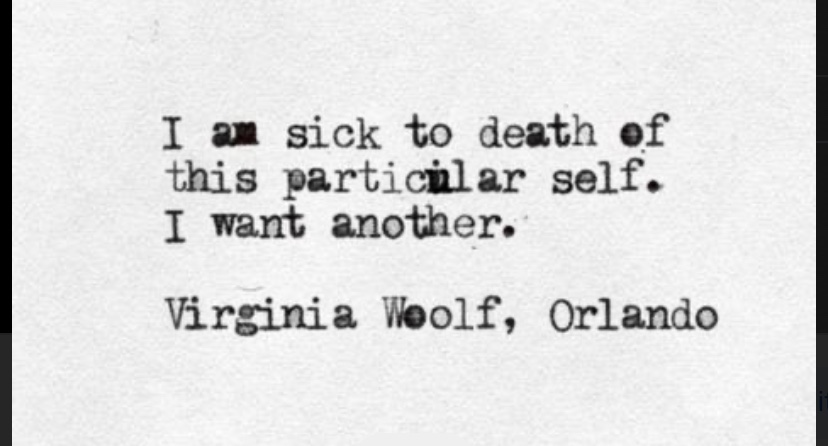
And now we start in on our third Woolf book, Orlando. We’re going to take this one slowly, so I will tease your appetite with just a few quotes from the novel.
Read on! Let me know if you find favorite passages as you read.
See, I ended up posting more about Lighthouse than I did Dalloway. That being said, I’ve finished re-reading it. You? 😊 So I’m going to go ahead and start re-reading Orlando so I can get a jump on it. We all know how holiday weekends end up. We’re staying home for Thanksgiving, to be safe, but I intend to make up for that by watching every single holiday movie on Netflix that I haven’t already watched. (Or as many as my sweetie will tolerate.) Reading and prepping posts early is a good idea, if you ask me.
Speaking of, have you watched the adorable Dash & Lily on Netflix? Oh my gosh, so cute.
Oh, and I’ve just started my third novel. I hadn’t meant to get serious about it, but I made out with it at the office Christmas party and now we’re dating. (JK, JK!) Don’t tell anyone, but I’ve already written 50 pages! (I wish I could say more, but you know how it is…I don’t want to introduce it to anyone until we’ve dated awhile.)
Now, how to wrap this Lighthouse study when there’s so much more to say? As I read, I had so many things to share, but each could fill pages.
Here are the story’s ending thoughts, our eyes on Lily as she finishes her painting: “Yes, she thought, laying down her brushes in extreme fatigue, I have had my vision.”
Sure, you can argue that Mrs. Ramsay is the book’s main character, but I would disagree. Lily is the one who notices, who watches, who paints observations of the main couple and their family, of all of those around her. She memorializes them in her painting with her acute scrutiny. I, for one, am grateful she did.
We could talk about Mr. Ramsay and his insistence that he and his youngest children go to the lighthouse. The two clearly don’t want to go. They decide they will fight tyranny to the death, meaning they won’t give their father the time of day. James never does capitulate, but Cam softens when their father asks her about the new puppy.
Most of the long trip, however (I’d like to know exactly how long, because they bring a meal and Mr. Ramsay brings a book), Mr. Ramsay spends his time reading. Is the actual visiting of the lighthouse the point, then, or is it the journey? It would seem the journey is not what he cares about. Much buried there.
Lily imagines the journey at the novel’s end. She thinks they must be there now. It’s then she can complete the novel, so she’s not the only one who has gotten stuck in this loop, this unfulfilled promise.
While I think it would be difficult to make a good film of this book because so much of the importance and beauty of it is in the prose, its structure would lend itself to that.
And that leads me to more thoughts, on and on. I want to mention other spoilers that I won’t, of Lily’s imagining of what happens to various members of the family’s circle, of actual facts versus her impression of them, impressions that change.
By the book’s end, her attitude towards even Charles Tansley softens. Art helps her “see” life.
I’m going to stop now because I don’t know where to stop. One line leads to another! And guess what? I didn’t even really touch what I covered in my master’s thesis, because I mined that for novel number two. (“Briscoe” is in its name, so…)
Remember: we start Orlando next! Have you read it before?
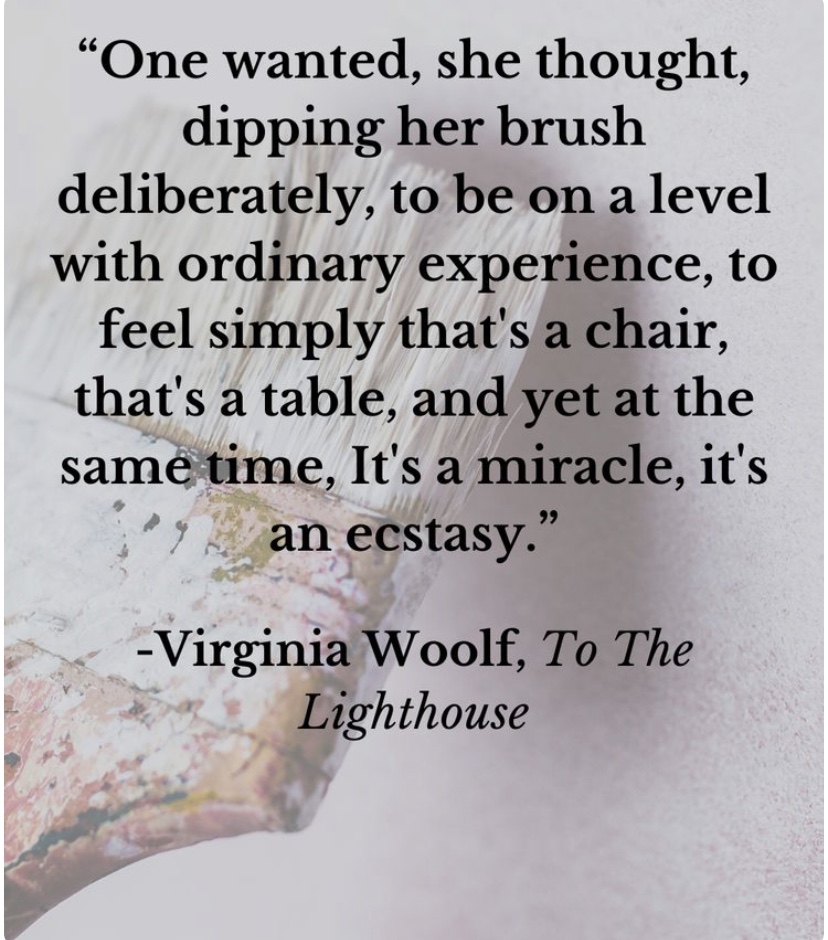
This is one of my favorite passages in Lighthouse. As a human, this has always been my goal, to pay attention to the ordinary moments of beauty and to elevate them.
At the funeral for my husband’s grandmother a few years ago, the minister came around beforehand and asked for memories to share. I was surprised at how many of them were mine that he mentioned during the service and how teary the family got as each was brought up. I was glad I spoke up.
What had I noticed?
Strawberry pie…the scent of apples stored in their breezeway…fresh apple cider…country magazines stacked neatly on the coffee table…ribbon salad…heaping bowls of mashed potatoes…rabbit show trophies…that and so much more signaled we were at the Drudges’.
My aim as a writer is to recall those average, everyday moments and hold them.
Recently I shared a photo with my daughter of a bottle of wine on our dining room table. “I can’t believe you still have that table,” she said. We’ve thought of replacing it, but there are paint and marker blotches on it from her and her brother. We studied and read there together. We played cards and ate how many meals at it?
The table is just a table, but it’s also a miracle, a memory.
I didn’t mean for this to turn into a Thanksgiving post, especially not so early, but then again, it’s fitting. I’m thankful for miracles of all sizes.
Do you have a favorite passage from this book? Almost finished reading it? I’m rounding the corner. For some reason I don’t remember the last bit being quite so long. Not that I want to leave Lily’s side any time soon.
Remember when I wrote a post on Robin Lippincott’s excellent Mr. Dalloway? He’s turned up again in connection with Woolf in this Lit Hub article on the art and the audience, but this time for his Blue Territory: A Meditation on the Life and Art of Joan Mitchell (Tidal Press). Both his meditation and Woolf’s To the Lighthouse (our Autumn of Woolf book of the moment!) are highlighted alongside three other books as wrestling beautifully with the artist’s process in this Literary Hub article by Scott O’Connor. I find this type of philosophical, deep, “thinky” book beautiful.
But I would add Of Human Bondage to the O’Connor’s list.
I hope you’re not tiring of my admiration for Robin’s writing, because it’s not going away any time soon. And I highly recommend you order his book.
Rather than recite the insightful list, as a takeoff on both Robin’s writing and a nod to the above, (merging both sentences here, my apologies),“Oh, just look at the goddamn article!” 🙂
Hubby and I are honored to be aquainted with the uh-maaay-zing author Lesléa Newman. She’s been on some of our trips abroad as a writing workshop leader, and came to speak in Fort Wayne a couple of years ago. Of course we went to hear her!
The author of Heather Has Two Mommies and many other gorgeous and groundbreaking books, she always calls us “the Drudges” in the sweetest tone and asked once on a tour bus all about us, even though she was sitting behind us and no conversation was necessary. Her kindness is not mere politeness. She’s a gem.
She posted this link to her poem on Facebook today, and even though I was getting ready to go to work, it transported me so that I nearly forgot what I was doing. I had to share the link. Please read it and enjoy!
Am I the only one who gets stuck on a simple punctuation mark when reading? I want to understand everything Virginia Woolf writes, even down to her choice of punctuation, but while reading Lighthouse today, I came across a sentence with a comma in a place I would not have chosen. (If you’re reading the book for the first time, it’s good, really good, isn’t it?)
Here:
“Simple, obvious, commonplace, as it was, Mr. Bankes was interested.”
I don’t quite understand the placement of the comma after commonplace. I would have left it out. I feel that as it was is strongly connected to commonplace. Am I missing something here? Do let me know if there’s some grammatical rule or exception I’m overlooking.
Hubby says I should consult other editions and her original manuscript, and I would, except that involves walking upstairs and having internet that works and that’s a no right now – thanks, Mediacom, for sponsoring this outage. I’ve learned when to let good enough be good enough. Besides, I kinda like pondering.
What do you think about the sentence? How do you read it?
Photo by u0412u0430u0441u0438u043bu044c u0412u043eu0432u043a on Pexels.com
Charles Tansley is a douche nozzle. There, I’ve started with the most heinous character in To the Lighthouse.
And yet. And yet I pity him. (You might question my use of “douche nozzle.” That’s exactly the casual language that I would use in a classroom if talking about literature and would hope my students would use as well. I would view it as a sign of someone actually engaging on an emotional level with the material. If you don’t feel it, how important is it to you?)
Things I loathe about him:
He tells Lily Briscoe, an introverted, aspiring young artist that “Woman can’t write; women can’t paint.” How dare he discourage a woman, yet alone deprecate all of womanhood! Can I get “Charles Tansley can kiss my ass” on a t-shirt, please?
He sucks up to Mr. Ramsay and worse, mimics him, pissing off Mrs. Ramsay even though she still tries to be nice to him.
He insists on carrying Mrs. Ramsay’s bag when she tells him no. (I also see that bag as a sexual metaphor, and thus find it even more crass because of that.)
Years later we learn that Lily Briscoe sees him giving a lecture and he’s a boring blowhard.
Why I Pity Him:
Because he comes from a large family with no money, and thus has no idea how to comport himself among the “better class.”
He obviously feels inferior, and I feel sorry for him for that. But he doesn’t have to make himself feel better by putting others down!
He clearly idolizes Mr. Ramsay and is trying to live up to what he, Ramsay, has become. His idolization gives Mr. Ramsay some of the unending admiration he needs, but it must also give Tansley something he needs. Perhaps in a large family he was overlooked?
It seems that while he gets some notice by lecturing when he’s older, much like Mr. Ramsay, he doesn’t achieve what he had hoped.
He still hasn’t learned, even when fully an adult, how to interact with others.
a reproach to them, gave a different twist to the world, so that they
were led to protest, seeing their own prepossessions disappear, and
clutch at them vanishing. Charles Tansley did that too: it was part of
the reason why one disliked him. He upset the proportions of one’s
world. And what had happened to him, she wondered, idly stirring the
plantains with her brush. He had got his fellowship. He had married;
he lived at Golder’s Green.
She had gone one day into a Hall and heard him speaking during the war.
He was denouncing something: he was condemning somebody. He was
preaching brotherly love. And all she felt was how could he love his
kind who did not know one picture from another, who had stood behind
her smoking shag (“fivepence an ounce, Miss Briscoe”) and making it his
business to tell her women can’t write, women can’t paint, not so much
that he believed it, as that for some odd reason he wished it? There
he was lean and red and raucous, preaching love from a platform (there
were ants crawling about among the plantains which she disturbed with
her brush–red, energetic, shiny ants, rather like Charles Tansley).
She had looked at him ironically from her seat in the half-empty hall,
pumping love into that chilly space, and suddenly, there was the old
cask or whatever it was bobbing up and down among the waves and Mrs.
Ramsay looking for her spectacle case among the pebbles.
Lily also uses her painting to reshape her relationship with Tansley:
“…(she and Charles squabbling, sparring, had been silly and spiteful)
something–this scene on the beach for example, this moment of
friendship and liking–which survived, after all these years complete,
so that she dipped into it to re-fashion her memory of him, and there
it stayed in the mind affecting one almost like a work of art.
Her own idea
of him was grotesque, Lily knew well, stirring the plantains with her
brush. Half one’s notions of other people were, after all, grotesque.
They served private purposes of one’s own. He did for her instead of a
whipping-boy. She found herself flagellating his lean flanks when she
was out of temper. If she wanted to be serious about him she had to
help herself to Mrs. Ramsay’s sayings, to look at him through her eyes.”
–To the Lighthouse
These paragraphs are so dense and rich that I could write pages about them! Look how open-minded and understanding both Lily and Woolf are about this wanker. And yet I do pity him and would likely be nice to him AFTER setting him straight about women and the arts.
As I’ve hinted before, this book is not merely character or plot based, and certainly not in my estimation. But I had to get that out, had to talk about the worst aspect of the book first off. (And it’s not a fault of Woolf’s, it’s an important point to make about how society still thought of women artists as a whole. But the “Women can’t write; women can’t paint” bit makes me so angry!)
In the novel as a whole, Tansley’s opinion is at odds, creates tension, with Lily Briscoe who attempts to paint Mrs. Ramsay and her son James, tries to capture the essence of Mrs. Ramsay. From the get-go we have Tansley saying it’s an impossible task, although he just condemns all of women’s painting and not just Briscoe’s ambition. It echoes Woolf’s fears that she won’t get across what she wants to. I love that Lily is not only painting out what Mrs. Ramsay is, but she also uses it as a way to understand others, much the way I write to figure out the world. I get that.
A glimpse of future posts: This reading of the book has me pitying Mr. Ramsay more than before, too, even though before his whiny, demanding behavior irritated me. And oh, those geraniums in the book that he beat in his blind pacing made their way into my second novel. There’s a secondary reason for them in mine: for a short time, my father worked at a nursey in New Jersey. He brought us home geraniums, and I have been overly fond of them ever since. Did you ever notice that their leaves smell a bit like a tomato plant’s leaves?
I plan to try to post a couple of times a week on this book. I’d love to post more, but I can’t promise that at all because it’s getting busy around here again with marketing, with writing, and on. I have so much to say that maybe I’ll write a few post in stream of consciousness writing just to get it out. 😊
If only we could sit together and read pages and talk and talk about them. Well, we can do that here as we are able. If not now, chime in later!
I’m overly excited to talk about Lighthouse. It’s such an important novel to me. And yet since my second, about-to-go-on-submission, novel deals quite a bit with this book, I have to be careful. No spoilers!
Although here’s one tidbit: I turned the lighthouse into a forest fire lookout tower in my novel. One I know from my childhood.
This is not the actual tower of my childhood. But it’s a good representation.
Lighthouse and I had a rocky start: Here I was in Senior freakin’ Seminar as a non traditional student with all of these bright English majors and I’m panicking because it’s a beautiful book but I’m lost. I know I can’t just enjoy it. I have to understand it, and I don’t. Or didn’t. It feels like Woolf gives with one hand and snatches that “truth” back with the next. I was hella confused and frustrated, because her essays were so straightforward by comparison.
Enjoying and embracing ambiguity has come slowly to me.
I was reading Lighthouse in bed that first time (my favorite place to read) on a rare morning at home and just not understanding it at all. Then, out of nowhere, we had an earthquake! In Indiana! The bed rocked as if I were in our vacation rental boat. The quake must have jarred something in me or the universe loose because slowly after that, I finally understood it. (Well, it took six times all told of reading it to really feel I had grasped it, but that day opened me to it.) If I were more metaphysically inclined, I would say Woolf “zapped” me during that earthquake. Maybe I should say it anyway.
Not before I felt like a wretched, ignorant loser in class, a fake, a fraud, behind the rest did I get it, though. They were a great bunch, but come to find out, some of them found their “insight” online, something I could never imagine doing because I’m so stubborn.
So I read it again. And again. Then there was class discussion, and I was relieved to discover I was getting it. I had always been a fan of stream of consciousness, so that wasn’t throwing me. I really can’t say what was except for sure that cursed, hopeless, existential-crisis making middle section. I needed some plot back or at least hope and fast before I got stuck there. But then, ah, then, life returned. Lily Briscoe with her art returned. And I knew everything would be all right, even if it did feel icky to have such mixed feelings about the characters.
Nowadays I don’t so much try to understand it as reference it, even though I’m pretty confident that I do understand it. For me it’s like flipping through a book of poems by Neruda. Though my Spanish isn’t great, I just get something from his poetry, first in Spanish, then the translation.
With Lighthouse I get that gilded, heady glimpse first, you know, the surface shine that makes you happy. And then I take the words in, focus on the meaning. Damn, is there meaning. It’s Morse code about life. Do yourself a favor and open it up pretty much anywhere and sample it.
When it came time to choose a book to write my senior thesis on, did I play it safe? Did I choose Alice in Wonderland or even Cuckoo’s Nest? I had other choices, too, but I’m Kit in A League of Their Own: “I like the high ones.” (Wait, does that movie title have echoes of Woolf? A Room of One’s Own? I say yes!)
Not only did I write my thesis on it but I was told I was the only English senior that year to receive a high pass. Boom.
Then I was asked to read it at the Indiana College Education Association Conference. I did. Oh, and I won first place, even though I planned to leave before the awards were announced because I’d had such a good time talking about the book I didn’t even consider I might win. It barely registered to me that there was an awards ceremony. I laughed and laughed when I so unexpectedly won, and if memory serves I bought something pretty with the prize money. Boom again.
Naturally when it came time to do my grad school thesis I continued the trend and wrote on Lighthouse. It was such a luxury to write even more about the book. I wish there were some way to write observations page for page about a book, and a place to share it. I know that would take years and I’m not sure anyone would want to read it, but that’s just how much I still want to know about the novel, how much it affects and guides me. I’m sure there’s so much more to discover about it. (Ooh, maybe there’s a new podcast to start?!)
No wonder, then, that I turned to my love of this book when I began my second novel. It’s been a challenge but so meaningful to wade into that great pool of words and sift them between my fingers. To mull on phrases and mysteries. To ask what’s behind the behind.
How can a novel be simultaneously lovely, dark, and deep? That bird flight of a POV, the cadence, the intertextuality, the clever use of an artist observing a couple to speak of marriage. All of this while Woolf also memorializes her own mother and the family’s summer trips.
I have multiple copies of this book. Ironically, of all of my class texts for Senior Seminar I borrowed my copy from the library because money was tight. I could hardly bear to give the book back. I only did so when I was able to find an identical copy online. And dear librarian, if you see pencil markings in your copy, I’m sure it was some other patron who did that. (I don’t condone abusing library books but I may have forgotten a time or two it was a library book I was holding since it didn’t have a crinkly (cellophane?) cover.)
Maybe this book won’t do for you what it did for me, won’t cause you to scrutinize anything and everything you’ve ever believed, but then again, maybe it will. I’m excited to run through it yet again.
Have you read Lighthouse? What did you think of it?







 dremadrudge.com
You must be logged in to post a comment.