“I was there. You had only to come and see me.” Isabel Archer, Portrait of a Lady
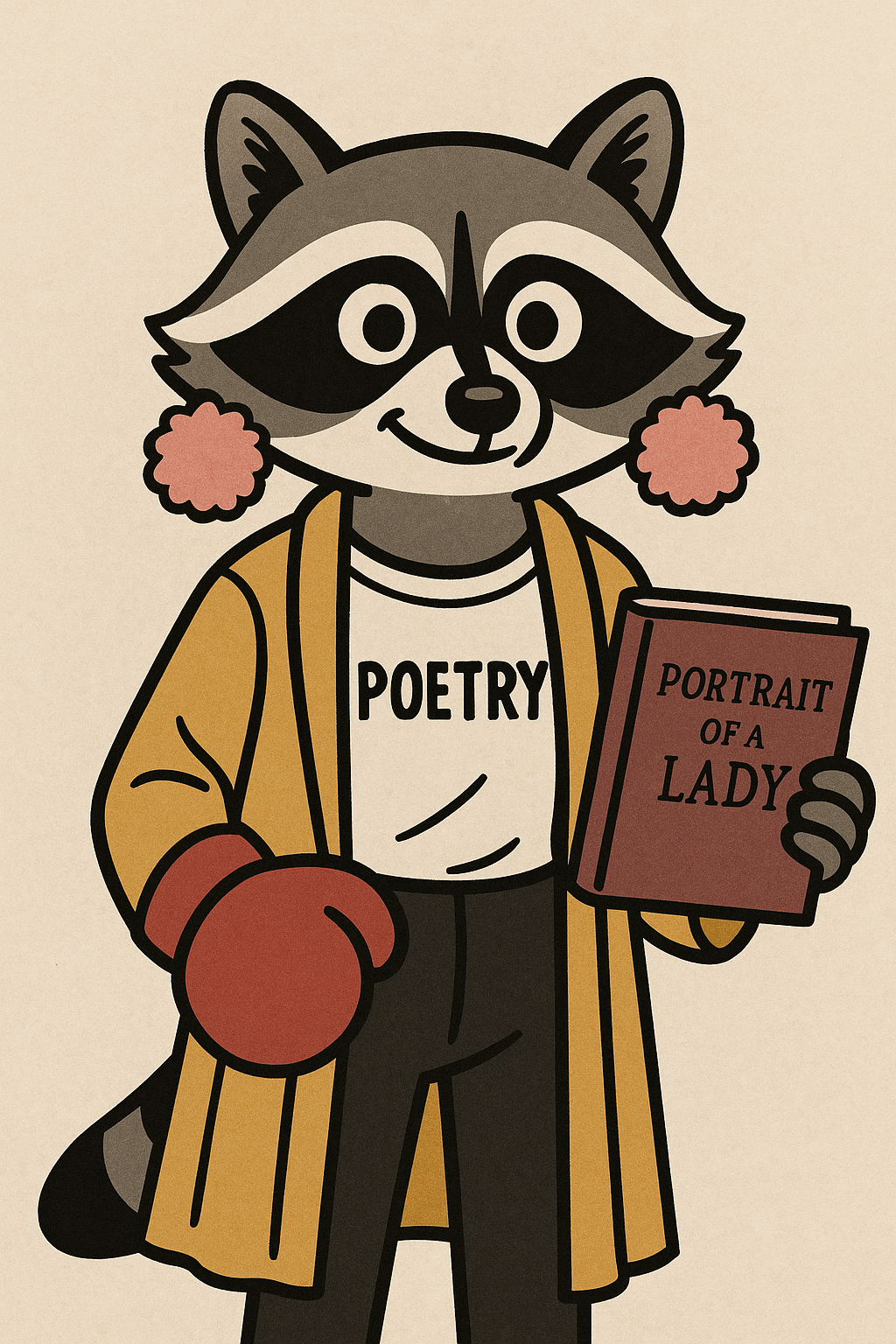
Word Raccoon’s Log: 6:47 AM, My Sunporch. Wearing: Pity the Fool. It’s a robe. With a backstory. Hold your horses.
Playing: “Landslide.” But not in the sad way. Not really. At least not this morning.
Last night I sang along to “Landslide” until my throat was raw. Girl, if you’d seen the post (since deleted) that I saw, you would have, too. I’m beginning to despise social media.
Stevie Nicks says:
“Can I handle the seasons of my life?”
I will, but I might ruin my throat while doing it.
Last night, my son was unexpectedly available for much-needed hugs and dinner, and he grinned and finished my sentence when I asked if he minded if we went for…Chinese. He’s not the biggest fan of it but he is a fan of me, so he, his father, and I ate what is one of the only real meals I’ve had this past week. I haven’t cared and haven’t noticed I didn’t care until yesterday when Barry and I were watching a cooking show.
“I think I want some real food,” I said. Well, it was steak, so probably any meat eater would’ve started salivating. And before you go assuming Barry’d be the one grilling, some days it seems as if we will slap battle one another with spatulas and tongs to decide who gets to. (No grilling utensils were harmed in either this post or real life.)
We have very different grilling methods. But that’s another post for another day.
Earlier in the day, Henry James held me together as I listened to Portrait of a Lady while cleaning…I wonder if Henry James ever imagined someone would be listening to his book while wearing rubber gloves.
I’m not a big fan of audiobooks unless I’m doing something else while I listen. This was just right for keeping me situated inside myself. I fully intend to switch back to my physical copy next week. BTW, hadn’t meant to listen to more than the preface, but I couldn’t not.
The last thing I remember hearing last night was an exchange between Isabel and who was it? Sorry. So specific, LOL. I’ll have to re-read it – I was drifting off. It’s been a long time since I’ve read it.
Anyway, the gist of it was the woman with Isabel was horrified that Isabel might not know how to comport herself in her current situation. And when Isabel said she should like to know what other young women might do, her companion asked if it was so she could imitate it, and Isabel said no, so she could decide if she would or not. That’s a delicious distinction.
Oh, Isabel, you beautiful, independent, woman. We’re the same person.
I could write reams on mindless compliance vs. well-considered decisions. And don’t get me started on manners…I could write even more!
Etiquette as a guide to making everyone comfortable and, to an extent, signal the expected, sure. If you’re at a State Dinner. If you’re in church. If your grandmother has come to visit wearing her pearls. Of course if you can manage it without compromising yourself. But mindless, nitpicky “use this fork or be branded a rube” nonsense? Stop it!
(And yes, I do know which fork to use when. But sweetie, if I am sitting beside someone who uses the wrong one, I’m going to do the same because that’s the greater kindness to them rather than embarrass them by pointing out that they’re not using the “correct” one.)
Superiority signaled by the lifting of an eating implement is surely an inferior sort, am I right? That says nothing about your good qualities and everything about your bad.
And think of the monuments dedicated to “the dignified.” Wait…that’s not a thing?
Damn right it’s not!
The soul does not carry a copy of Emily Post’s finest work.
And it’s not that I won’t allow others their tiny, comforting rituals (I see you pulling that cape of decorum around your shoulder, your face. You’re not Dracula, darling! I see what you’re trying to hide with it, and may I say, there’s no reason to, babe), it’s when others bind and entangle with their manner of manners that I chafe and want to call for a pair of scissors.
Following the rules of living is not…living, my precious bird.
Not that I’m passionate about that type of thing or going full tilt Word Raccoon on you. There’s a phrase about even a king must…WR, stop! We get the point!
I reckon death makes you think of unusual topics heatedly, at unexpected times.
And lest it be misunderstood, I’m not embracing anarchy or foolhardiness or rebellion, though perhaps of the smaller kind I am. Just tiny, freeing acts overthrowing the unelected governor of your soul, babe.
The muse can dig through the layers, but why make it? Wipe away the dross. Have a napkin, sugar. It’s linen.
A peal of laughter just came from somewhere in the neighborhood, and it was glorious. So free, so spontaneous. It’s early yet, so I’m surprised but delighted to hear it.
A friend sneakily dropped by a gift and two cards yesterday.
Someone said she is sending flowers to our house today. There will be plenty of lovely flowers at the funeral home, I assume tomorrow, so it will be nice having them at home, too. It’s so thoughtful of her.
The messages, texts, cards, and subtler, drive-by condolences continue. I feel them all, even if only out of the corner of my soul’s eye. Something in me senses them, and I huddle them to me.
Oh, yes, the “Pity the Fool” robe backstory. So a couple of years ago I ordered a velveteen holiday jacket. Bold gold. It was long, stately, and I thought even after the holidays I might wear it occasionally on a night out with boots and jeans as a statement piece.
When it arrived, it was a glorified robe, and I now wear it as such. It’s gold, like boxer-robe gold, and it’s so tacky it makes me smile every time I see it. So now my neighbors get to see it, too, when I wear it (over my clothes) on the porch.
You’re welcome.
Here’s hoping this warmup has summoned the muse. I’d like a good writing session today. I have had some Coke Zero and I am ready to shadow box the world.
And if I start singing “Landslide” again by noon? So be it.
Ooh, look who slept till 6:30. Good on me. (I hate that phrase for no reason, but I’m keeping it.)
The day stretches out in front of me. Chores, sure, we’ve covered that. Coffee or Coke Zero soon. Please, God.
On today’s crucial to-do list:
Sort the breadbasket (it gets away from you)
Reclaim the fruit bowl from the brink
So far, my brain, currently emperor of this body, has not deigned to tell me whether I’m allowed to work, read, or write. So far, nothing appeals.
I tried a poem about the Libby app earlier. It’s got promise. It’s also wonky. It feels like that essay on the evils of technology that Frank self-importantly writes in You’ve Got Mail. We’ll circle back.
I’m not sleepy. I don’t want to watch someone else’s version of reality.
A friend texted: “How are you feeling?” “Not myself.” “It’ll take a minute.”
Unfortunately, I already knew that. She, too, has had occasion to grieve. Bless her.
But I’m a little more myself today.
Yesterday, I found that Henry James author’s preface to Portrait on Librivox and listened to it like it was a sermon after having read it for about two hours. Got it, got it, got it.
Yesterday, I napped.
I woke up.
I remembered again.
Every time, like new.
It’s probably ridiculous, but I don’t like her being alone at the funeral home. I want her planted between my dad and my sister where she belongs. Safe. Protected.
That version of her at the hospital, the “her” she’d become in the past year, wasn’t her, not really.
Not until I looked through the old photo albums to make the memory board.
Then, the woman who died became also my mother, not just the sweet, quiet shell I helped guide into the afterlife. I’m tempted to overexplain that. But you get it, right?
A friend is having a party on Saturday. When I saw it on the calendar, I texted her: “Obviously, I won’t make it.” She understood.
Last summer, she and I drove out to the cemetery. I “introduced” her to the plot. We sat on my dad’s bench and caught up. (My mom’s name is on it too, but until now I never thought of it as “their” bench.)
Forgot I have to wash my hair today. It’s getting long because I’m growing it to donate. But for now, I’m kinda liking it this length, even though some would say at this age I shouldn’t. Washing and drying it are a whole thing with these curls. Today, that’s fine.
Today will fill itself up. No doubt. But my fingers ache with the weather, and everything I write feels like it belongs in a children’s book—just… not the content.
I have nothing fresh to offer. Nothing witty. I’m not even listening to music. Just the hum of the fridge.
I took an ibuprofen, am flexing my fingers. They’ll be fine soon enough.
Wish the rest of me would recover as quickly.
I’m pretty sure there’s nothing to read here. Nothing to see.
My to-do list leading up to Mom’s service on Saturday is shrinking. Finally. (I should say this is just my portion of the list. Other family members have done as much and more.)
Mom’s obituary? Published.
Poem written for the memorial cards? Check. Notifying family and friends? Done. Trying to overlook the pettiness of people who are hurting? Ongoing…
Picture board of my branch of the family? Complete.
(Upside down and with sparkle. It makes sense if you see it. It’s more collage than not; if you know me, that tracks.)
I had no idea it would wreck me to make it, going back through picture albums, choosing, piecing together memories, some half remembered. Crying over the one where my mom and dad look so happy on a random afternoon on their living room couch, the one with my kiddos with them, my son at nine squished against my mom, beaming while Mia, our eldest, smiles at my dad. Wishing I had even more choices.
I listened to Comfort Eagle in my AirPods the whole time as my heart ached over so many things. This time, there was a good ache in there, too. Thankfulness.
Tomorrow is house cleaning day. Not glamorous, but necessary. It’s fine. No, really. As long as someone else does the dishes. And the laundry. And maybe cleans the bathrooms.
I’m joking, of course. Barry and I will likely divide the chores like a thoroughly modern couple. Unless oops, I sleep in and the chores magically do themselves? Wink. (He’s taking his remaining bereavement days late in the week to help prep for visitors since the funeral is on Saturday.)
What will I do in the meantime? Like, today? Unclear. It’s not even 5 am yet here I am, at the page.
It’s a strange, liminal time. I want to write but do I really want to?
(Sorry/not sorry for practically live blogging. This is hows we drains the pain, lovelies.)
Wind gusts may drive me indoors today at the cafe, dang it. But I’ll still be…what? At my laptop, hoping for inspiration, for ?
I’m saying it might not matter because I’m not gonna exactly be a productivity czar.
I was there yesterday, and one of the employees who knows my niece came up and hugged me. She had heard. I barely know this young woman and yet I felt myself leaning into her. There’s something to being able to draw strength from others after all.
Another employee who did not know, but a sweetie, had newly learned I was an author (idk how she heard that) and was telling me she had ordered one of my books. I thanked her, of course, and she asked me if that’s what I do when I’m at the café, write novels?
Sometimes, friend. Sometimes.
Sometimes I’m doing other work.
Sometimes I’m automatic-writing poetry that I never remember to let cool long enough to polish. (I’m gonna fix that. It deserves more time and attention.)
Sometimes I’m blogging, which is another word for flinging your soul like Mardi Grad beads and hoping they land with the right person. (It? Which is the referent? See, I don’t even know right now and don’t care enough to figure it out. It’s 4:50 AM, HERBERT. DON’T GIVE ME ANY PERFECTIONISTIC SHIT. Except now I do care, but I’ve mentioned Herbert and I like to leave in mentions of that cranky SOB.) STET.
Where is Word Raccoon? I don’t feel her yet this morning. Please tell me she didn’t come and go with my mother’s illness and passing? I like my writing friend!
Regardless, I’m not feeling poetic today, although doubtless a few stubs will pop up, attempt to sprout. Time will tell. Not really interested in my novel right now. The comic book has proven a nonstarter at this point. The humorous essay is…not what I’m feeling. Screenplay I mentioned yesterday? Not a serious contender. Too much formatting, am I right?
Maybe I’ll bring the James novel with me, flip through that author’s preface again as if I’m on a fainting couch.
Maybe I’ll sit in a straight-backed chair, iced coffee in hand, and see what ghosts show up.
What am I saying? This isn’t Hamlet.
And I’m not sipping from anyone’s chalice without knowing what’s in it.
This grief is real, but so is my creative fire. Just banked over for now. Waiting. Gathering heat.
This just in: Word Raccoon is out of the shower and indicated the bathroom mirror where she has written the following…something??
Oh, Word Raccoon. Proceed.
Not really writing just means The icicles have built up on the roof Snow has matted and sagged the top of the house.
Grab a ladder, a shovel, And get to work.
What if I took my prose tools and crafted Poetry with them?
Possible? Would it mean more about prose Or less about poetry?
Is there a different peg board layout
In the garage
For the two genres’ tools?
Has anyone talked about the margin?
I understand that’s a factor. Not margarine. (But maybe I should make toast. With butter. Not that other. Gross.)
Is word play even poetry?
Is sound? Image? Narrative? Navel gazing?
A collision of ideas too hot, too disorienting, for prose?
Maybe it boils down to Who owns the mineral rights.
And dammit, I said I wasn’t going to Poem today.
Not really sure I have, though.
Word Raccoon, that, my darling word gobbler, is a word grab bag, not a poem, but it’s a start.
NOTE: WR spat out like three more prose poems today that are so rough and so improbable and so huh that IDK what to do with them. Maybe NOTHING. I think I’m gonna start a “don’t you dare let this horror show see the light of day” file once my mind is clearer.
The one about elote and a certain animated series? Oh WR, am I to be left with no dignity? WHAT IS WRONG WITH WRITING ABOUT PEONIES, MAYBE? THEY’RE GORGEOUS RIGHT NOW. MANET PAINTED THEM – ARE YOU BETTER THAN MANET, MY LITTLE JABBING WRITER FRIEND?
It’s late in the afternoon. I went to the café. I read James’s Author’s Preface in Portrait of a Lady again. It took two hours. I want to read it again soon. It’s a nourishing meal after days of dry cookies. It’s dense, but not that dense – my brain is just wandering that much, and I thought it deserve a thorough reading.
At the café, lovely people extended their condolences. The man with the dog named the same as my maternal grandmother came around the corner and mentioned the weather. That’s a midwestern “I’m sorry” if I’ve ever heard one, so soft and tender you almost wonder if you are right, but you know you are because when someone does something out of character after they have heard people talking with you about your loss, it’s not nothing.
People in doorways said sorry, people from the street. Nods that mean almost as much as a card.
You’re grateful for it all.
And you’re not sorry that you spent time with James. In fact, he mentioned other authors you adore, too, and now you have a summer reading list.
It was like sitting in his living room and relaxing on the sofa. I am fascinated with how he dissects the architecture of his book. (I LOVE looking at a book’s architecture, stripping it down to the bones. The bones are maybe the most interesting part. Is that weird to say?)
James seems like that rare person you’d just as soon listen to as talk at, or someone you’d be just as happy to sit quietly with. Yes, I can see me sitting with him some more in the coming days.
P.S. If the posts slow down a bit, assume I’ve either a) found a quiet pocket of peace or b) been buried alive under a pile of photo albums, prose and poetry fragments, and metaphorical toast. But that’s a big if.
Trigger warning: this post discusses my mother’s homegoing in detail, as well as my sometimes-nonsensical grief reactions. Read with care.
Not listening to anything today but the birds. Hubby is tending to the playlist for my mother’s funeral, so I think I’ll leave the music to him for now.
We lost my mom. She was ready; we were ready to see an end to her suffering. It’s an honor to sit with someone through those final hours, even when it hurts so much you want to climb out of your own skin.
It’s funny how the petty things drop away at times like these, and you wish you’d known love could feel this clean and uncomplicated.
I’m tired of crying. Tired of my throat aching. Tired of being angry. Tired of thanking kind, well-meaning people when I have no bandwidth.
The day before she passed, I took half a Benadryl. Then another. Then told my husband I could either be grumpy with him or mean to the public. He said, “Kill them all,” and meant it—metaphorically, of course.
I tried one of those meditation videos full of soothing profanity: “Eff Everything,” I think it was called. Spoiler: not mean enough. There are no words strong enough when your grief brain is chewing mourning pills.
Then I tried a regular meditation. When the honey-voiced guide said, “Breathe deeply,” I whispered, “Like my poor mother can’t?,” and had to shut it off. I knew I’d make it through the emotional wave, but I also thought I might need help swimming.
That night, while watching some idiotic movie, I told Barry it was either another Benadryl or a beer. He rushed to the fridge. Word Raccoon, my writing companion on my shoulders, has claws when she talks grief unfiltered, though she always regrets it afterwards.
Earlier, at lunch, the street corn arrived. I had asked about it, but the server brought one ear and handed it to Barry. He wanted some elote too, but I was the one inquiring, and without hesitating, I said, “My mother is dying. I’m taking the corn,” and I did, with a flourish. Barry got his ear later.
I wore a Mama shirt I normally loathe to the care facility—Midwestern cotton tragedy, gifted to me for a review and never before seen outside the house. But it felt right. “Mama” printed four times across my chest in varying patterns and shade, like I was cheering her on from the sidelines.
It didn’t help. I was furious that all my will and love couldn’t stop what was happening. I kept imagining grabbing her and sprinting down the tunnel back toward life. Like the end was negotiable.
A friend and I have met at my writing café a few times to discuss the construction of screenplays. I came up with an idea that he absolutely thinks I (maybe we) should run with it: you get so many people whose deaths you can veto, and you have to decide who to use them on.
I wish I had that veto power right now.
At Mom’s bedside, I dipped a toothette (sponge on a stick) into Coke Zero and stuck it in her mouth. She sucked on it like it was communion wine. A holy moment. She was so dry it hurt to watch. I apologized that it wasn’t Diet Pepsi — her favorite.
After a while, we went home to rest for a bit. Then came the call: death was likely a couple of hours away. We returned to be with her.
There are no comfortable chairs in a care facility. Just bad options. The recliner reeked. Who uses cloth furniture in a place like that? I brought pumpkin cinnamon Febreze, and suddenly it smelled like pumpkin cinnamon rolls. (Is that a thing? It should be.)
There was humor bedside. Music. Tears. Not enough air. Too much. Minor irritations. Bigger ones you swallowed because it wasn’t about you and everyone was just doing their best.
I rubbed lotion on her hand, knowing she was minutes from leaving us, and pulled her arm closer, as if I could keep her. I couldn’t bear to break physical contact.
Watching her breath slow was brutal. The spaces between stretched longer and longer. But I thought about her hours of labor to bring us children into the world, and I told her she was doing a good job. That she was almost finished.
We told her Dad had waited for her long enough on the other side. That we wouldn’t ask her to stay for us. (Hospice teaches you this. Sometimes your loved ones need permission.)
I called her “Mommy.” I called him “Daddy.” Like I was little again. I didn’t think about it until later. That’s the line I almost can’t write because it hurts. It was a big thing once in a World Lit class discussion I attended on Turgenev’s Fathers and Sons where the son calls his father Daddy and some of the students objected. It was a large class, so I didn’t speak up and say that’s the Southern way. I only lapse into it sometimes, but during something like this? For sure I use the diminutives.
After it all, we waited while they cleaned her up. Then, another goodbye. Then the funeral home came not in a hearse, but an SUV. Because “hearses upset people.” What nonsense. Death is not optional. It’s part of the deal. Ugly, inconvenient, and real.
Another goodbye as they took her away. I drifted towards our vehicle insisting I needed a sugary, icy Sprite. I rarely drink Sprite and the one I ended up with (it was past midnight, I think, or near) was no good but so what? Nothing was going to be any good right then and I knew it.
Earlier that day, I’d yelled to Barry that death is a design flaw. That we’re handed these luminous, improbable chances to live, only to have them crumble on some arbitrary Sunday. Like our lives are leases and we only get so many miles before we’re repo’ed.
I used my concert hall voice, not my indoors voice and I regret nothing. I wasn’t yelling at him, just yelling in general.
Then I yelled about a mysterious old man crotch smell in the house. It was probably the ripening bananas, and it wasn’t so bad; I just needed to scream at something.
When we’d first heard she was worsening a week ago, I said no thank you. I just did this with Tammy. I’m not doing it again. Pass.
Obviously, you don’t get to pass.
People ask what I need. I don’t know. Minute to minute, it changes. Yesterday, after a long nap, I asked Barry if he needed anything. That was new. It felt good to offer something back to someone who’d given me so much support in the days before.
Now, I want stillness. Solitude.
We have nearly a week ahead of smiling, nodding, hosting, thanking. I’m grateful for those who care. I am.
But I also intend to escape to the coffeehouse and sit on the porch as much as possible. Not to be fixed. Just heard. Or not. Just sipping. I find the most comfort in those who know how to be quiet with me. You ever notice that some people’s stillness is better than a conversation?
Or, better, if someone offers you something, anything, to think about besides your grief.
I want Sunday to come, the day after the funeral is scheduled, and Barry’s band to fill the house with noise so I can flee it guilt-free knowing he will be cared for in a way that heals him. I will find whatever bright corner to write in that I can in a town that rolls up its sidewalks on Sundays. (Cliché, don’t care.)
A parting thought: I’ve found that when death comes, the jagged edges drop away. What remains is just love. Just grace. The skewer comes out clean.
So here I am. Writing. Hurting. Healing. Doing what I do. If it’s self-indulgent, I hope you’ll understand. It’s how I process. I know it takes time.
Word Raccoon has been at my side. We have written poetry throughout; with one freakish one today called “Sphincter Circus” about circuitous relationships because that gal doesn’t know how to leave a tender moment alone.
Love your people. Let go of anything you can. Humaning can be messy, but it can also be beautiful. I just mean that in general. Witnessing death is a good time to consider how you want to live. (I think I’ve earned those somewhat sappy but sincere lines. Hey, I gave you old man crotch smell above to balance it out.)
And as I saw on a card once: Don’t hold onto a grudge. You know how slimy they are.
From Snorton’s Anthology of Dislocated Literary Composition (Abridged) Chronology of Writing While Elsewhere: An Addendum
1880: Henry James attempts to write The Portrait of a Lady in Florence, fails to ignore the view.
1881: James relocates to Venice, where writing remains difficult due to… Venice.
1920s: Hemingway allegedly writes about Michigan while drinking wine in Paris, proving geography is a mood.
2014: Author writes about Paris while sitting in a Starbucks in China. Does not see Paris anywhere but in her mind’s eye and possibly in her teacup.
2025: Word Raccoon demands drums during May existential crisis. Writing on the sunporch about love, repression, death, and James’s preface. Cookies involved. (Editor’s note: the cookies were oatmeal raisin. Of course they were.)
I’ve been re-reading The Portrait of a Lady, or attempting to, but I keep getting looped back into James’s utterly unhinged and relatable author’s preface.
It’s a mini master class in both writing in general and on the importance of physical place (as in the actual location of your precious body, not place as in setting) to writing.
(Word Raccoon says she would appreciate more glitter here, and frankly, perhaps James would, too. This book is very cool and sophisticated. Just hang on – I’m gonna get you all hot and bothered, Word Raccoon style, below. It will be worth the wait.)
James talks in the author’s preface to Lady about writing the novel in Florence and Venice, as he had his previous serialized novels, but he says that these places are such big characters they are themselves universes meant to be written about and so it was no good for him to stare out the window hoping to find an image when the entire city was a world-class art museum.
I’d go further and say places like that are dangerous for writing a novel set elsewhere unless you totally ignore windows or writing outdoors.
I remember writing about Paris in China, and there was…a disconnect. Especially since I was in a Starbucks at the time. (I also tried writing outdoors there, but, you know…air quality. Nothing like flecks of black soot on your face as you write about a child and her sheep.)
If you’ve read Hemingway’s excellent A Moveable Feast, you know he says it seems to him that “Maybe away from Paris I could write about Paris as in Paris I could write about Michigan.” I thought of that as we sat in the Luxembourg Garden eating lunch where he claimed to have “hand hunted” pigeons to eat. I wish I could’ve shared my crepe and red wine with him.
James isn’t quite saying the same thing about place, but it’s parallel.
And also, not enough people talk about where you choose to write can be nearly as important as what.
Like, when I write outdoors, my eyes and heart are on constant scan. The rhythm makes it into my writing. Squirrels? Their physical selves, their scampering. The cars that go back and forth. The time lapse stream of energy as people come and go with lattes in their hand.
Place affects what we write, what we can write.
At this moment I am writing on the sunporch waiting to go to the care facility where my mother is on hospice. My husband is mowing the lawn. My heart is both here and a thirty-minute ride away.
This post isn’t about place, not really, or my dear mother. Maybe you can tell me what it’s about while I mark time and begin despising cookies which, surprise, surprise, are not magical pills that let you forget what is happening.
I’m about to drop a poem below that will seem completely inappropriate and ill timed. For those who do not yet know Word Raccoon (or what it is to be a complex human even though you are one even if you refuse to acknowledge it): emotions, being human, the messiness of it all can coexist. No, must coexist. They just do.
You can get one of those trays for toddlers that separates the food: sliced strawberries here, hummus and pita wedges, there, but in the end, it’s all food.
I’m maddeningly distracted by James’s distraction by place. How did we get here? Forward, Word Raccoon!
Five Stars. Would Emotionally Obliterate Again.
I’m re-reading Portrait of a Lady and I have questions. Like, do James’s characters make eye contact when they make love?
It’s a fair question. Just how deep does the repression flow?
You have to take delight
(and a blow torch)
in watching a glacier
thaw
to patient your way through and yet, I’m still enthralled.
(That’s a half rhyme. That’s allowed, right?)
But could I bear to be so
close
to
all I want if his eyes are squeezed
tight?
P.S. It’s not indecent to write during these times, it’s necessary. And yes, James would probably faint seeing patient used as a verb. That’s how the Word Raccoon interacts with literature, though, makes it her own.
Now Playing: “Sugar Shack” by Jimmy Gilmer and the Fireballs (1963) (It was my parents’ song because my mother’s parents once owned a tiny restaurant called the Sugar Shack. Isn’t that adorable?)
Today, I ate Mega Stuf Oreos and drank Coke Zero while trying to write my mother’s obituary. (She’s not gone yet, but it’s coming quicker than we thought. As in, any time now. Or maybe a few days. We don’t know exactly when, but she is actively dying. I wish I could ease her passing.)
I didn’t finish the obituary. But I did finish a row of cookies. And if grief has a flavor, it might be whatever that hyper-sweet cream is in the Mega Stuf version. I didn’t ask to be alone with a whole package. And yet.
What I did do was pick out a dress for her—accidentally, in that weird way grief hands you a task without calling it what it is. I ordered it, thinking it was for me. It wasn’t. It never was. She would’ve been horrified by the price in real life. That hurts, too. She deserved nice dresses, but she preferred making do. (For the record, I was given the stunning wrap dress to potentially review. Not sure how to review it now: “Gorgeous blue dress. Great for funerals. Oh, not to wear to the service—to wear for… that other part.”)
I should’ve known when I ordered it, for how blue it was, that it was for her. It matches the color of her eyes—the same eye color she gave four of her five children.
This is the stage where you start making lists that are NO FUN. Obituary.
Dress. (Check.) Songs she loved. (Okay, that one’s been kinda fun, but also: which song list? Preservice? Service? After service? Graveside?)
Funny things she said. Things you wish she had said. You find yourself wanting to stick a silly hat on her head. Pop on some sunglasses. Maybe place a daisy behind her ear. Do a photo shoot to remind yourself, dammit, she was here. Her body is soft. Pliant. Malleable now in a way that feels like betrayal.
Hospice is a strange beast. People crowd in with good intentions—ministers, nurses, paperwork, decisions. They mean well. And yet I find myself wishing I could put up a sign that says: “She’s transitioning. We’ve said what needs to be said. Let us sit now. Quietly. Let us see her out with our own words, our own presence.”
I sang to her yesterday. A song she loves, by a Nashville duo she met once while visiting us and adored. My husband tried to find it but ended up playing a different one by the same singer. My mother opened her eyes. She raised her hand.
I should’ve been happy. I was. And I laughed and cried that it wasn’t my voice that brought her back. (I’m not saying she could help it. It was just a moment of bitter irony, HERBERT! And I’ll say what I want to say—I will not be all gumdrops and sugarplums right now, and I won’t apologize for that, either.)
When she opened her eyes and looked around, she saw me crying. And though she can’t talk right now, she looked like she wanted to know why I was crying. I thought, Shit. She knows I think she’s dying. And she probably didn’t know she was dying. And now she does. And it broke my heart.
(Of course, truth is, she probably didn’t really see me. She’s only partially aware—and only at times.)
I kept stroking her hair and her hand, admiring her long nails with their pink polish. She would’ve hated me treating her like a poodle. But I couldn’t help myself.
What is poetry, if not all this? I’ve been writing it all morning in between tasks—not the tidy kind that fits in a journal, but the kind that oozes from your fingers when you’re sticky with grief and cookie innards. It comes and goes. Like songs. Like memory. Like appetite.
Later, I’ll go back to the obituary. I’ll dig up facts and try to distill a life into a few paragraphs. But not now.
Now, I’m letting myself be loud and petty and grouchy and grateful and angry and so, so tired and so wired all at once. And maybe a little high on sugar.
I’m not apologizing for how I feel or what I’m writing. I know this post isn’t closely proofread or smoothly structured or, I don’t know, even well-conceived—and that’s fine.
Yes, there’s some Word Raccoon trash in here too. That might seem inappropriate to some. But that’s how we survive, chief. We find the humor. We invent the bizarre. We tell those who can’t be here—physically or emotionally—it’s okay. I know you would, if you could. And a half-gesture is better than none, if that’s what you can manage. I don’t think less of you. Though I wish…
Grief makes a poet of you, whether you want it to or not. And it makes an eater, too.
So if you need me, I’ll be at the dining room table. Pen in one hand, cookie in the other. And soon, by my mother’s bedside again.
But I am writing. I promise you—I am writing, whether I have a pen or a laptop or not, I’m writing.
And when it’s time, May flights of angels sing my mother to her rest.
Mackinac Island, a necessary breath in our life right now. When Barry’s workplace offered to take a busload, Word Raccoon tapped me on the shoulder and asked to go. Anything for WR.
We packed too many snacks, not enough caffeine, and a firm resolve to stay politely aloof from the group tour energy—until Word Raccoon got into the pecan fudge and all bets were off. Horses clattered, carriages swayed, and wild trillium bloomed by the hundreds. These are my notes from the weekend: part travelogue, part memory, part sugar crash.
We kicked off our Mackinac Island trip with a travel day that felt equal parts midwestern fever dream and sitcom B-roll.
We boarded a charter bus with 44 other eager travelers and settled in for five rounds of bingo (none of which I won and usually I’m a very lucky person, so maybe I should’ve seen that lumpy hotel bed coming later in the evening) and the first twenty minutes of National Treasure, which ended abruptly when we stopped for lunch and never resumed. I’m still wondering what happened to the Declaration of Independence. (I actually know; I’ve watched it. Obv.)
Lunch was at a folksy roadside stop inside what used to be a Burger King play place. I could almost smell the ghosts of ball pits past, but that didn’t stop us from ordering surprisingly great sandwiches: a Reuben for me that could’ve fed two, a crispy fish sandwich for Barry I tried not to gag at when I saw it came with tomato.
I adore tomatoes, y’all, they’re practically a religion to me. But on fish? No thank you. That’s heresy.
When we spotted a solo booth at lunch, we sprinted for it like it was a Black Friday sale. Everyone on the trip was lovely, but Barry and I had made a quiet pact—not to get too chatty. We had an island agenda and didn’t want to be absorbed into the group cruise vibe. (Hey, Word Raccoon knows what she needs. She’s not unfriendly, she just knows when she needs a break and to pre-grieve.)
At check-in at the hotel, I guarded the luggage as it came out from under the bus while Barry dashed inside. We’ve got a system. Still, the front desk assigned us two queen beds instead of the king we’d requested. I said it was fine since I am adaptable, but if only the queen had been somewhat comfortable and not a runner up for the worst mattress my back has ever known.
After a quiet pizza night of recuperation, we slept in. We’d seen the forecast: cold winds incoming. So I bundled up—coat, scarf, gloves—and we asked the hotel to call a shuttle to take us to Shepler’s Ferry.
Turns out, having a ticket waiting for you does not mean you skip the line. No, you stand in it for half an hour like everyone else, just with a ticket in your hand instead of on an app. SMH.
Still, the ride over was fun, rain spattered.
Once on the island proper, we made the only logical first choice: a fudge run. Because even though I know better, I didn’t pack snacks, and we were trying to grab a carriage tour (which, of course, you cannot reserve ahead of time) and thus did not want to eat a proper meal until after. So we shared bites of pecan fudge like two sugar-starved fugitives. Was it a questionable snack? Yes. Was it also exactly what I needed? Also yes.
What the fudge did not solve was my lack of caffeine. The hotel coffee had been appalling—muddy water with a dash of bitterness, like someone had run a breakup through a Mr. Coffee. And in an uncharacteristic packing misstep, we had plenty of snacks that I for some reason did not transfer to my purse for the trip to the actual island the next day either but no drinks. With no convenience store in sight and the hotel offering zero caffeine options except that coffee, we ducked into a nearby restaurant on the island for lunch to make up for the deficiency.
I ordered brisket tacos, which I’d generously call “tourist tacos.” Not prefab, thankfully, but aggressively vinegary—as if someone had mistaken acidity for sophistication. Barry had a smash burger he declared very good. But it was a burger, so… there’s only so much lyricism I can summon for that. (Except to say burgers are their own food group. I have sophisticated tastes in some areas, and I’ve eaten food from around the world, and I am adventurous but also, burgers are life.)
Most importantly, they had Coke Zero, the official drink of Word Raccoon and me.
We opted for the scenic carriage tour because we were tourists, and it seemed wrong to leave the island without sitting behind a horse for at least part of the day. It was just us, three horses, a guide, and 35 of our closest strangers. (Technically, the first carriage had two horses and maybe a dozen or so people—twelve? fifteen? It’s hard to count discreetly and it doesn’t matter to you except I’m a counter. Eek, Word Raccoon, they don’t need to know that!)
The ride was charming in that “I’m doing this for the story” kind of way. The guide was cheerful, the horses majestic, and the scenery was lovely in the quiet, cedar-shadowed kind of way that sneaks up on you. Every now and then the driver would stop to give the horses a breath, and while we paused, he’d share trivia or open the floor to questions.
I almost always had questions. But I stayed quiet because I’m usually too curious for my own good. I didn’t want to be thrown off the carriage by the others.
Then the tour turned uncanny.
We began to pass clusters of trilliums—my favorite wildflower from back home in West Virginia. When I was a kid, whole hillsides would go white with them in spring. Seeing them again here, blooming in cool shade, something in me cracked open. I thought I should count them. Then write that many poems. But before I could get past twenty, I lost track. There were hundreds. The idea stuck anyway—a dare from the woods. Write as many poems as you need to. (See, you were going to tell them about the counting anyway!)
I remember gathering a bouquet of them from the mountainside for my mother for Easter morning once. They were exquisite. They are also protected, but I didn’t know that back then and maybe they weren’t then. Not sure.
Endangered now, as my mother is.
And then there was Arch Rock on the island, rising out of limestone and lake air, older than everything else we’d seen that day. The wind came through it like breath. It was crowded. It was the kind of place you’d want to be alone to truly feel it.
Need I even mention the lakes? Ah! Majestic.
By the time the tour ended, I was full of feelings I wasn’t quite ready to name. That’s when Word Raccoon reemerged, completely unbothered and absolutely high on fudge. She popped out of my tote bag, sticky-fingered and smug, like she’d just pickpocketed a pastry chef.
She was unimpressed with my trillium reverie, how dare she. She wanted to know where the real coffee was and whether we could sneak into the Grand Hotel gift shop and buy a magnet without paying admission. Then she left a chocolate thumbprint on my notebook and said, “You write the poems. I’ll steal the metaphors.”
Which, fair. Fine.
On the way home, she refused to sit quietly while I read because she wanted to write poetry.
“Why,” came her question, “read The God of Small Things on a moving bus full of the sound of rustling chip bags and soda bottles being screwed off and on when writing is clearly the correct choice?”
She has never swum in the silky waters of that book. Poetic, lyrical. Confusing but in a good way, because you know you’re going to have to be clever to figure it out. “A bee died in a funeral flower,” I quoted. WR didn’t care. She wanted to write, not read.
The beautiful parts: The spider, the garlic skin, the whispered “Tomorrow” are not random details, and she doesn’t get that. In The God of Small Things, these are the kinds of images where everything lives. Love, memory, grief are all distilled into gestures so small they nearly vanish. Metaphors so sharp and tender they might as well have initials carved into them. The book returns to this again and again: the world may be cruel, but love survives through attention. Through tiny, precise noticing. Sometimes “I see you” is best said sideways, through proof of life through the survival of spiders.
Word Raccoon muttered something that may have included the word “masochist” and disappeared again beneath her scarf. Possibly converted. Possibly just plotting a snack. Definitely not reading with me. Traitor.
I finished the book before the trip’s end, frustrated that I hadn’t given more time to this book that would surely reward a re-reading. But I’m all writing energy right now, not so much reading. Except the Twain bio I’m reading by Ron Chernow. I’m only a few pages in, but it’s absorbing.
I did manage to write a few poems on the trip—some full, some still in stub form. That’s what I call the underdeveloped ones: stubs. Not quite poems yet, just sharp little nuggets lodged in my brain.
Titles from the weekend include:
List of Items I’ve Apparently Bought to Leave on the Ferry and in Taxi Cabs
On Reading a Book I Don’t Want To (It’s Me, Not You)
Nobody Teaches You the Essentials (How to K!ll If You Have To)
Random White Girl
I Don’t Like Old Man Liquor Stores
Extra Hotel Bed: a History
Some stubs stayed stubby. Others came out already sharpened. Like this one, from a moment so fast I almost didn’t notice—except, of course, I did. I don’t know where these things come from (I can tell you where the details come from, but not why they join one another like a patchwork quilt. I wrote a poem in bed last night about a YouTube short I saw talking about a Pompeiian slave with a gold bracelet weighing a pound on her wrist given to her, the engraving said, by her master. That just didn’t sit right with me, so I explored it with my pen.
Then there was this little freak below. I saw the random white girl in the ferry line; I didn’t see Amelia. I would’ve said so if I had.
Random White Girl Beige clip Black jacket Forgettable face Climbs the line As if part of a group She’s not.
She’s as solo as
Amelia Earhart’s last flight.
Gotta get me a Beige clip Or a forgettable face.
Yeah, right.
No one counts Noonan.
What got me, maybe more than anything, was the silence. Streets without cars. No horns, no revving engines—just footsteps, bicycles, and the occasional clop of hooves. The sound of a town paced for presence, not speed.
My dream, basically.
Then…we came home. Oh reader, I’m not trying to trick you into reading this, but here’s where things fall apart. Or maybe I do. I’ve been yammering on, not wanting to face this.
I fear the time has come to tell you that my mother’s health is going steadily downhill, and that numb/painful feeling from not so long ago when we had to say goodbye to my sister is returning after a weekend away with the knowledge that it’s creeping closer, her eventual resting place beside my father, beneath that beautiful bench in the Laketon Cemetery in the plot that has accidentally become a family plot, all too soon I fear will be occupied.
I sit on that bench and talk to him sometimes. I tell him I’m sure I’m boring him, but I’m going to “catch him up” anyway. Funny thing is—I leave out the hardest parts. Like I wouldn’t want to burden him in the afterlife.
My sister, then a space yet for my mother, then my father beside his sister (they adored one another), then my aunt’s husband, a man given to woodworking. When we left West Virginia behind, we left the family cemetery, too, never thinking about us needing another.
I foresee sleepless nights ahead for myself, too many poems written, good, bad, and in-between, too many blogposts, too many books read, any place to lay my head other than this certain, sure knowledge that be it now or in the coming weeks, it’s coming, and it may well take my breath for a day or two or three…forgive me if I’m self-indulgent over here. I want to surround myself with all of the things and people I love, the things that always make me happy.
Come find me, even if you think what I need is silence.
I know how to keep from drowning, but just. (Not trying to sound dramatic. I really can tread like nobody’s business. I just don’t want to have to.)
NOW PLAYING: Rabbit Heart (Raise It Up) – Florence + The Machine
Posted by Word Raccoon, Keeper of Glitter and Occasional Wisdom
Friends, nibblers, poetic co-conspirators! I’m doing joyful somersaults in the compost heap today. My little raccoon heart is pitter-pattering like a vintage typewriter on a deadline. Because guess what?
🌟🌟🌟 Three of my poems were published TODAY by the wondrous and wild-hearted Word’s Faire! 🌟🌟🌟
The trio: 🧬 ‘Franken Eden’ 📝 ‘A Post-It Note Found On Your Self-Worth’ 📵 ‘Don’t Do It (Or Leave Her on Read)’
Yes, yes, my darlings, that’s TWO Eden poems flanking a quiet little bridge built out of sticky-note ephemera and self-worth (which, you’ll find, is more durable than one might think).
It’s been a few years since I read Frankenstein start to finish (some books haunt in layers), but lately I’ve been thinking Shelley might’ve had more than monsters in mind.
These poems are scraps of my sparkle-soul, stitched and scribbled and sung. Franken Eden is a stitched-together myth, all verdant glitch and ache. Post-It sticks to the mind in lowercase hums. And Don’t Do It, well, let’s say it’s the warning label scratched into the bark of the Tree of Knowing Better. It’s not completely Edenic but then again it’s not not Edenic. (Just read the last line and you’ll see. LOL.)
I wrote them when I was full of feeling and fig leaves, and I’m sharing them now with full sparkle and no reservations.
If you read them or if you whisper one of these lines to a mug of tea later, or scrawl a phrase on your bathroom mirror in eyeliner after you read them, then thank you. That’s the dream. That’s the point.
With ink on my paws and a glitter trail behind me, —Word Raccoon 🦝✨
So honored and delighted. Thank you, Word’s Faire, for choosing my poetry. Dear Reader, I hope you’ll take a moment not just to read my pieces, but to explore the beautiful, strange, and brilliant work from the other writers over there. It’s a feast. Don’t miss it.
Newly back from Mackinac Island over here, so playing catchup.


 dremadrudge.com
You must be logged in to post a comment.