Manet: Portraying Life Exhibit at Toledo Museum of Art now through Jan. 1

It happened so quickly — my husband left the newspaper open for me on the dining room table, since he had to go in so early.  This was this past Saturday.  After I fed the fish I saw the paper and bent closer to examine the Manet painting there.  Then I read that it is at the Toledo Museum of Art, which is only three hours from us!

I squealed, ran upstairs, mapquested it, printed directions, and began frantically texting my husband: “Plz plz plz can we go tomorrow??” He said yes!

Needless to say, we went yesterday, and I am not at all sorry!  I saw many paintings I thought I might never get to see — the collection brings together paintings from nine different countries.

This exhibit is the first of its kind mounted, cosponsored by the Royal Academy of Arts, London, and Toledo is the only U.S. venue where the show will be.  It will be there until January 1, 2013.

Some of the paintings there: The Tragic Actor, Berthe Moirsot with a Bunch of Violets, The Monet Family, The Railway, and many more!  If you are a Manet lover, you must see this collection.

Portrait of Emilie Ambre as Carmen

There were so many I loved that it’s hard to pick out a favorite.  Some of them I wasn’t familiar with.

A pair of the Dutch tradition in particular stood out: Boy Blowing Bubbles and The Smoker.  They both hold long objects which involve blowing through them — the smoker holds a pipe, of course, and both resultant substances — bubbles and smoke — signal the transitory nature of life.  One is old, one is new.  I would have liked to have seen these paintings side by side, but alas they were in separate galleries.  So I will combine them here, just for you.


What do you think?

For more information, go to the museum’s website: http://www.toledomuseum.org/exhibitions/manet/

How to Read a Painting

There are two styles of writing about art: looking at a painting and imagining a story based on it, and analyzing a painting and creating a story based on the artist’s process.

What do I mean by this, and what is the difference?  Okay, let’s look at a painting, The Old Guitarist by Picasso (image found at casasreverb.com):

One way of telling a story about this man would be to simply look at the painting and think, “Here’s an old guy with a guitar.  Hmm…I bet there’s a story in there somewhere.”  Then you start imagining what the man’s name is, and his family’s background.

But I prefer another approach.  I referenced this earlier by calling it “reading a painting.”  We can read a painting as surely as we read a book.  I should add that I am no expert, just someone who would eat art if allowed.  This is how I do it, anyway.

First, you stare at the painting.  Then you let it stare at you.  There is no room for the coy stuff here.  You open yourself to feel everything the artist means for you to feel and more.  If you are weak, forget about it.  You may even need to plant your feet wide apart.  (I have been known to faint in the presence of art.  No kidding.)

Then stare some more.  This only works if the painting calls to you.  I know it sounds over the top but I believe there is something about looking at a painting that reveals more than a little part of someone’s soul (both the observer’s and the artist’s). I know that I would likely have disliked many artists had I known them, but by seeing art rather than the artist, the man or woman does not get in the way.

Just as one does when reading a novel, one can read in many different ways.  I love color, and I will often trace the colors.  Obviously blue is an important color in this painting.  Starting at the top there is a strata of blues that seem to weigh on the character’s head which we quickly notice is cocked at an unnatural angle, suggesting perhaps that the character is dead.  That he looks like a saint adds to this thought.

The blue of the wall behind the guitarist is in a couple of wide bands of the same color that his gown is.  Everything is blue.  Of course blue immediately suggests sadness.  But it could also mean dusk.  Again, his age also suggests the setting of the sun of his life.

The man is folded in upon himself in a protective way.  He is in his own world and wants to stay there.  The cut of his clothing hints at poverty, but he is clueless of it since he is lost in his world of music. The guitar, a light brown to beige with a normally somber brown neck actually looks like a light source compared to the shadows of the blue.

Now, this is only one way to read the painting.  Of course I wouldn’t use what I just actually wrote in a piece of fiction based on the painting, but I would use what it has told me about the painting to build the story.

I would go further and study the brushstrokes, the shapes, the light source.  I would speculate on why there are both patches of blue and light on his forehead and legs and I would make much of it!  Picasso has told us more than enough to understand this man.  But had I not studied the painting, my story might have begun with this:

“The old man was cold, but on he played.”

AFTER studying the painting, I would be more likely to say something like:

“He didn’t much mind that he was dying, since he found his fingers played almost as well as they always had.  The closer he approached the place of blue the faster he played, as if redeeming something of his bloodstream.”

Getting INSIDE of the painting is vital to understanding it and allowing it to suggest a story.

Committing to Your Ideas

I love the mad rush to write on a new idea: it’s like making love to someone for the first time — there goes a shoe, there a shirt…well, you get the picture.  But after you’ve had your way with the idea, it’s splayed on the bed, and you have to decide if it’s relationship worthy, if you are going to commit.  Are you going to spend any more time with it, or is it out the door?  Can you see yourself lovingly, endlessly tweaking its commas, smoothing its verbs, plucking its adjectives?  If not, maybe you’ve got the wrong subject.  (Lest you think I am a commitment-phobe, I have been married to the same man for 21 years now, or so he informs me.  He’s our family’s historian. I’m just tracking the fun miles.)

I have been known to hunker down with an idea and spend literally years with it.  I will let it have its way with me, and then I will pursue it.  Then I get bored with it, but it starts talking to me and I come around again — it’s very much like a marriage.

I love the writing process so much that I’m often reluctant to write “the end.”  (Wait, does anyone actually write “the end” anymore?)  But part of committing to your ideas is also knowing when it’s time to say goodbye.  Or, maybe a better way to say it is knowing when to allow others into the conversation: i.e. readers.  Because then the characters cease to even seem to be your own (you know they never were, right?) and they belong to everyone.  But that’s what it’s all about.

So commit to your ideas, but in order to be successful you need to be a serial committer: once you’ve finished your part in that story’s life, trust that the next idea will be waiting.  And it will be.  If it’s not, drop me a line.  I’m full of ideas.

Vermeer’s “Girl with a Pearl Earring” Coming to the US!

If you haven’t read Tracy Chevalier’s novel “Girl With a Pearl Earring,” perhaps you have seen the eponymous film.  Or perhaps you have been residing under a large rock.  Well, here is our (because I want to see it too!) opportunity to see the painting that inspired them both.

Not much is known about the painting, other than that it was painted by Johannes Vermeer.  We don’t even know the year he painted it (circa 1665) and whether or not it was commissioned, though recent evidence seems to suggest it is meant to be a “tronie,” which is a Dutch term for a painting of a head not meant to be a portrait.  Intriguing.

The painting now gleams after the 1994 restoration work:

Photo source: http://en.wikipedia.org/wiki/Girl_with_a_Pearl_Earring?vm=r

The restoration work indicated that the background was meant to be a deep green, but that the background darkened significantly over time.

The exhibit, “Girl with a Pearl Earring: Dutch Paintings from the Mauritshuis,” features 35 important paintings by Dutch Golden Age masters including Vermeer, Rembrandt, Fans Hals and Jan Steen and will be stopping in the United States first at the de Young Museum in San Francisco from January 26 to June 2, 2013.  Then the paintings will next go to Atlanta’s High Museum of Art from June 22, 2013 through September 29, 2013.  From there it will make its last stop at The Frick Collection in New York City from October 13, 2013 to January 12, 2014.  After that they will make their way back to the newly renovated Mauritshuis in the Netherlands.

Other paintings in the collection include: Johannes Vermeer, “Girl with a Pearl Earring,” ca. 1665, Carel Fabritius, “Goldfinch,” 1654, Rembrandt van Rijn, “‘Tronie’ of a Man with a Feathered Beret,” ca. 1635, Jan Steen, “The Way You Hear It, Is The Way You Sing It,” ca. 1665, Jacob van Ruisdael, “View of Haarlem with Bleaching Grounds,” 1670–1675.

I don’t know about you, but I intend to move heaven and earth (or maybe it will just take moving my car) in order to see this exhibition!

A Recently (Re)Aquired Treasure

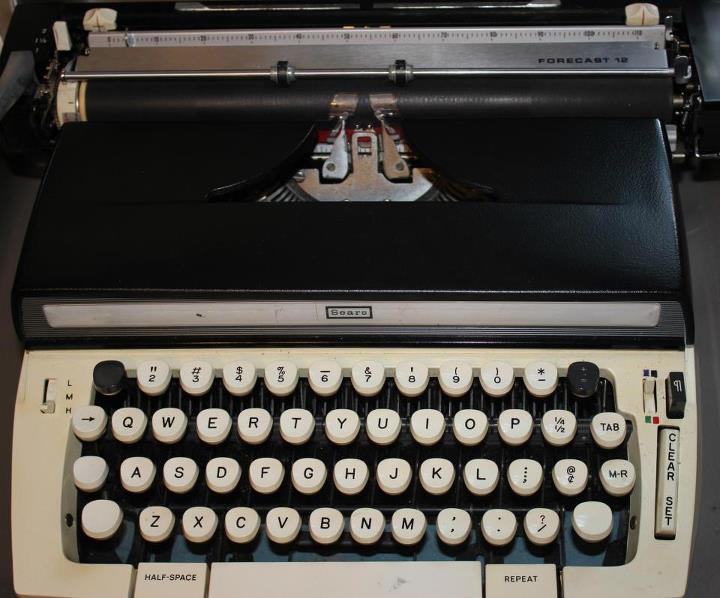
A few years after I began writing I was given two of my Grandpa Tommy’s treasure: his air organ and his typewriter.  I quickly decided the organ wasn’t for me — or maybe it was my parents who decided that after one too many of my horrible concerts.  But I did covet learning how to type, and so the journey began.

Grandpa wrote poetry and called himself “The Coal Miner Poet” because he was a coal miner as well as a poet.  Maybe because I barely remembered him I decided to start writing — I wanted to feel connected to him.

Just after I got the typewriter I remember hitting the space bar numerous times until a cousin looked at me blankly.  “You know you only have to tap it once, right?” I didn’t know.  I had no clue how to use it.

My memory is vague as to why the typewriter moved on — I believe a closer relative asked for it, but I do know that soon I was left without a typewriter.  After having mostly mastered the technique (You should see how quickly I can type now!  It’s effortless on a computer by comparison) and having written an unfathomable 13 pages of a “novel” (when I was in 7th grade), I felt bereft without it.

Recently my husband and I were on our way to the dunes.  I have been redecorating my writing room (I have insisted on a writing space in every home we have lived in, even when it has had to be a writing nook), and I mentioned that I really wanted a typewriter.  “Not to use, of course,” I said.  I had been trolling for them the night before on ebay.

“I want an inexpensive one, just a starter one, if you will,” I said.

We made our usual stop at the St. Stan’s Thrift Shop in Michigan City when we arrived in town.  There we generally stock up on inexpensive beach books, quaint jewelry, and LP’s.  They know our faces, and it’s nice to chat about the weather and load our arms with magazines and such.

Right after we walked into the shop I happened to look beneath one of the tables.  In front of me was a Sears typewriter.  I wanted to cry.   And it was less than $10!  I felt guilty buying it for so little.

Barry and I joked that I could bring it onto the beach and use it as what it was: the original lap top computer.  Of course in reality I brought pen and paper to the beach instead, but it was the first time I was eager to leave the water: I couldn’t wait to get home and put the typewriter in my writing room.

And here it is:

A nod to my grandfather, the poet.

Found! Renoir’s Paysage Bords De Seine

Why couldn’t it have happened to me?  Well, at least it happened to someone so that ALL of us could benefit: a woman bought a box of stuff at a flea market, rooted around in it and noticed a framed painting that caught her eye.

Upon closer examination she realized it was signed “Renoir.”  Experts have said that yes, indeed, this woman who chooses to remain anonymous has found a painting believed to be lost: Renoir’s Paysage Bords De Seine, a scene painting along the Seine River — a river my husband and I walked along several Paris days and nights in July of this year.

Source: http://www.inquisitr.com/325124/woman-buys-possible-lost-renoir-painting-at-flea-market/

The painting, sold in France in 1925, was later sold to a Maryland collector, Herbert May.  But just how the painting got from Mr. May to a box of junk sold for under $50 in Virginia is unclear.

The painting will be auctioned September 29.

This is a case where a painted that wasn’t even known to be missing turned up, so maybe there is still hope for those paintings we are still looking for!

In any case, I think all of us will be taking a closer look at boxes of bargains at flea markets and garage sales near us.

Soon let’s do a blog soon where we “read,” a painting, shall we?  Perhaps we can revisit this one and as mentor of mine says, “See what there is to see.”

UPDATE: The auction did not happen.  Why not?  Because it was discovered that this painting was stolen from the Baltimore Museum of Art in 1951.  Well, even though the painting will likely not net a financial boost for the “lucky” finder, it does return a piece of art to the world.  She can be proud to have been a part of the process.

S.O.S. Post: A Worthy Fundraiser AND a Chance to Win!

Dear Readers,

I was contacted to give books for a very worthy cause.  Please see the link below and consider giving if you are able.  This is a cause near and dear my heart.  You will have the chance to win (among many other cool items!) a signed copy of my Chicken Soup for the Soul: The Magic of Mothers and Daughters.

A family is trying desperately to get enough money to adopt  two special needs children from Eastern Europe,but so far they lack the funds.  These children are in danger, both physically and mentally and need to be moved ASAP!

Read the stories of these precious children and how to help them here: http://doloski.blogspot.com/2012/09/raising-funds-for-real-life-love-story.html

Sincerely,

Drema Drudge

To Protect and Observe

I am breaking my own rule by using a punny title, because so often a pun takes away the dignity of a piece, but this one fits.

We humans have our necessities: food, shelter, clothing, and, for some of us, art.  Recently CNBC aired a program called “Ripping Off the Rich.”  Among other things it highlighted how art is so tempting to thieves because of its compact value: one man walked into a museum with a shopping bag and walked out with a $200,000 Picasso pencil sketch, Tête de Femme.  The sketch’s owner, Rowland Weinstein, was quoted as saying “My goal is to keep this kind of work accessible to the public, and there’s always a risk to that.”  Thankfully the sketch was later safely recovered.

To combat the ever-growing art theft problem the FBI opened its own art theft department in 2004, and you can read about it here:http://www.fbi.gov/about-us/investigate/vc_majorthefts/arttheft/arttheft?vm=r.

act200.jpg

Displayed art is vulnerable, yet I am a firm believer that no individual should own world-class art.  (What constitutes world-class art is worthy of its own discussion and is certainly based on individual taste.) If I could afford, say, a Van Gogh, I would immediately have it copied and send the original to The Art Institute, no matter how much I adore Vincent.  Art should be shared, not hoarded.  But unfortunately this same impulse also makes art vulnerable.

phpUOVtd3AM.jpg

Image source: http://gothamist.com/2010/01/25/woman_falls_into_picasso.php?vm=r

A case in point: a couple of years ago a woman fell into Picasso’s “The Actor” and ripped it.

In 2011 A cleaning woman ruined Martin Kippenberger’s “When It Starts Dripping from the Ceiling” by “cleaning” the thin layer of paint from the pail’s bottom.

The damaged Martin Kippenberger artwork

Photograph: Bernd Thissen/EPA

I once heard a tale (I shuddered!) of a man and his friend who were at an art museum and the friend pried a fleck of paint off of a masterpiece. The man, his friend, and the artist will remain anonymous.  Such horror stories are not as rare as we would like.  This doesn’t even speak to the horrors of fire or water damage.  Add to that the intentional stealing of art, and we are dealing with a vulnerable form indeed.  What to do?

We could hide art behind glass, like Da Vinci’s Pieta is, but that’s so prophylactic and unsatisfying.  We could install metal detectors (as many museums have), but that would not solve the problem of human error (My dear daughter once almost fell into a Rembrandt.  Her father’s quick reflexes saved the day.)

I’m not sure what the answer is, but I know we must risk losses.  Art is vital to our wellbeing.  Or at least it is to mine, anyway.

Below is the FBI’s top ten art crimes list.  Here’s hoping all items are quickly reported as recovered, and soon.

FBI Top Ten Art Crimes

Iraqi Looted and Stolen Artifacts storm80.jpg
Isabella Stewart Gardner Museum Theft
Theft of Caravaggio’s Nativity with San Lorenzo and San Francesco
Theft of the Davidoff-Morini Stradivarius
The Van Gogh Museum Robbery caravaggio2.jpg
Theft of Cezanne’s View of Auvers-sur-Oise
Theft of the Gertrude Vanderbilt Whitney Murals, Panels 3-A and 3-B
Theft from the Museu Chacara do Céu
Theft of Van Mieris’s A Cavalier
Theft from E.G. Bührle Collection, Zurich – RECOVERED