L’Origine, a Review

When Lilianne Milgrom contacted me about reviewing her novel, L’Origine, I was astonished at the perfect fit of subject matter and time period with my sensibilities. A mutual acquaintance steered her my way, and I couldn’t wait to receive and read Milgrom’s book. I was right to anticipate it.

In 1866, Gustave Courbet painted one of the most provocative paintings ever painted, L’Origine du monde (The Origin of the World). The painting depicts a breast-down view of a faceless, naked woman with splayed legs, an unheard-of subject for its time.

Milgrom, an accomplished painter herself, opens her novel with her experience copying Courbet’s famed painting. I found her account of the process of getting permission to be a copyist at France’s Musée d’Orsay and her painstaking copying of L’Origine just as riveting as the novel portion of the book.

The author begins the novel proper with the controversial painting’s origin (no pun intended) and traces it through the history of each of its owners. Its journey through the world, through historical events such as Nazis asking for a ransom for its return, and on to its current home at the d’Orsay, is captivating.

It’s not surprising that the book is at times lusty, from individual encounters of painters with lovers to the, ahem, private uses of the resultant painting. One wishes the men so taken with the carnal nature of the painting would have spent more time dwelling on the metaphorical nature of it, on the deeper meaning of a woman’s vagina being the origin of us all, but that is a historical, societal shortcoming and not the author’s.

Milgrom’s fresh idea of following the painting’s sojourn mimics the physical act of birth, the passing on of power and life from one generation to the next, fitting in beautifully with what I believe to be the artist’s intent. Having once stood before the painting in contemplation myself, I was thrilled to read such a careful, loving account of it.

Rich with accurate historical detail combined with a creative imagining of what happened with the painting behind closed doors that no one could possibly know but that everyone wants to, Milgrom skillfully encapsulates the story of a painting with her discerning, artistic eye. Brava.

Nota bene: Milgrom obviously chose not to use Courbet’s controversial painting for her book cover, but it’s only a google away.

My Autumn of Woolf

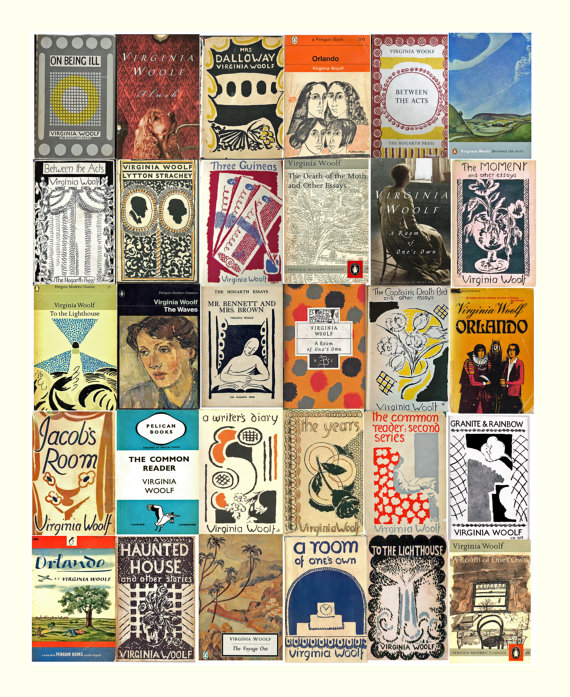
Many of you know that I am borderline obsessed with Virginia Woolf’s writing. To me, nobody, and I mean nobody, writes like her.

A sampling of my Woolf books

Before COVID-19 hit, author Gretchen Rubin had announced that she was going to have a summer of Woolf, which she subsequently postponed until fall.

Having just (I think) finished a tight draft of my second novel, I’m already feeling lost. Since Woolf plays a part in my book, what better way to feel I am still doing something constructive than to read all of her works this autumn? Thanks for the idea, Gretchen!

And Gretchen Rubin isn’t the only one contemplating a fall of Woolf. Literature Cambridge is also offering a series on Woolf’s major works: https://bloggingwoolf.wordpress.com/2020/08/17/virginia-woolf-season-with-litcamb-covers-her-12-major-works/

I have 2 1/2 bookshelves dedicated to not only Woolf’s novels and essays but also her letters and diaries. My intention is to eventually revisit all of her available writings. I have no idea where I will start; I think I will start with her first novel and the first volume of her letters and her journal for the corresponding time period.

And of course I will keep up with the Literature Cambridge schedule. I’m so excited! I love learning.

The hubby is also getting in on the Woolf action. He is currently reading Orlando. And he’s been reading volume one of her letters to me a bit at a time, which I find downright precious.

What are you planning to read this fall?

Growing Up “Laura”

Over on Grace Augustine’s blog today I talk about what it was like growing up in West Virginia with parents who were Little House fans. It was fun to take a slow stroll back through the years to hillsides of trilliums and blackberries. Thanks, Grace!

So, it’s a holiday weekend that many celebrate, but most of the ways we celebrate are out this year. How are we all doing? I’m making sausage pancakes today in part to honor the occasion, in part because IHOP keeps sending me tantalizing emails, and in part because my dad used to make them. (Read my guest blog post above.)

In addition, Hubby and I are watching totally random YouTube videos today. I’m such a true crime mystery person, and last night I stumbled upon an unsolved case that I told Barry all about this morning while he made us coffee. We decided to watch the video together because it’s set, sadly, at our favorite Indiana landmark. That led from one video into another…

Living Things

I’m not much of a plant person. I once had my heart broken when a plant my grandmother gave me died. I haven’t been able to become attached to any since. However, I do periodically think about becoming “planty.”

My hubby and I have a policy of “no living things,” because it’s easier for travel.

But the universe is trying to tell me something, I think. First, for my birthday a friend bought me a plant. I usually keep it at work, and so far it seems pretty healthy, once I remembered to water it, and once I learned not to overwater it. It’s a succulent, so I think he had an idea that maybe I’m not the best with plants, because these are easy to care for. I love it. And I kind of want to name it. Is that wrong?

Then there were the beautiful roses my dearest Barry brought me home on book launch day. What a sweet, sweet gesture. Although they’re almost beyond it now, I have enjoyed them so much.

A couple of days ago brought the latest: a friend commiserating with the cancellation of my book launch party brought me by some potted tulips. I adore tulips!

The first one was just beginning to open. Today, all have bloomed, and I’ve got to say, being surrounded by these beauties made me decide to bring my succulent home from work as we will not go back for the duration of that dreadful illness that must not be named.

Here’s to living things. All of us.

Meet Emma Lombard, Writer, Twitter Expert

I’m so pleased to have on my blog today Emma Lombard, historical fiction writer and Twitter expert. She has agreed to share about her writing and her best Twitter tips, so if you’re in the market for Twitter tips AND you want to hear about an intriguing historical fiction novel based on one of Emma’s relatives, keep reading.

1. Tell me about yourself.

I’m a bit of a globe trotter, not only having travelled to different continents but also having lived on different ones too! I was born in the UK, spent my childhood in Africa and my adulthood in Australia. I’m staying put now. I was eleven when I started writing my first novel and fourteen when I finished it. I had the incredible opportunity at the time (through a friend) to have my raw first draft put directly onto the desk of an editor at a large publishing house (oh, for that opportunity now!) Naturally, it was rejected (with some wonderful feedback, I might add). Alas, fourteen-year-old me didn’t cope very well with the rejection! So, I shelved the idea of writing for a while. It was only after my kids got to a more independent age that I began thinking seriously about switching careers from being an editor in the corporate world to a full-time writer.

2. Tell me about your novel’s origins: how it came about, how long it took to write, where it’s at in the publishing process, and anything else you’d like to share about it.

I corresponded by letter with my grandmother for most of my life (she lived in the UK) and it was in one of her letters to me, years ago, that she told me about my 3x great grandmother who eloped with an English sea captain when she was sixteen. The instant I read that little bit of juicy gossip, I knew I had the start of my first historical fiction novel. I started writing it seriously and with intent back in 2016. It evolved into four books but by late 2018, I realised I needed to go back to Book One and get it ready to query agents. So, after dozens and dozens of reads by my amazing beta readers, plus two professional developmental critiques, I was ready to send it to my editor. Being an editor myself, I know first hand that no matter how strong a writer you are, a fresh pair of eyes is essential. I’ve discovered with fiction editing, it is even more vital to get developmental feedback from seasoned eyes to spot plot holes or flag when your character is going off track. Plus, I am a chronic over-writer, so it was invaluable to get guidance about what storylines could be removed without it impacting the core of my novel. Having a professional editor to bounce things off has been the best investment in my writing career for teaching me to be a better writer. For anyone writing historical fiction, I highly recommend historical fiction specialist editor, Andrew Noakes from The History Quill.

I began querying agents midway through 2019 and I’ve had a couple of nibbles with a partial and a full request, which is deliciously exciting!

3. You commissioned some cover artwork for your novel. Please talk about that, the why, the who, and the result.

After researching how to build my author platform as a yet-to-be-published author (based on the invaluable advice of publishing guru, Jane Friedman), I really wanted to have something juicy to add to my new website, since I do not have a book out yet. So, I thought it would be wonderful to commission portraits of my main characters to display. Since I am planning to head down the traditionally published route, I don’t expect this artwork to be used on the cover of my novel, but I’m okay with that because the benefits of having my characters brought to life through illustration has been amazing.

I engaged the services of the supremely talented Sydney illustrator, Tara Phillips, after I tripped across her feed on Twitter. And as luck would have it, I had also entered a competition on Twitter by award-winning UK-based screenwriter, Eleonora Mignoli, who is also an amazing artist, and I won a portrait of my protagonist! So, now I have three wonderful characters to show on my website!

Little did I realise the stunning flow-on effect this would have for widening my exposure on my author platform (Twitter, Facebook and my website). Not only do I now have artwork that has now become part of my branding but I’ve even got one of my darling beta readers working on the most incredible piece of fan art! She is doing an enormous cross stitch of my two main characters, starting with Grace. Readers can have an exclusive peek at the monthly progress on this masterpiece if they sign up to my newsletter, By the Book.

4. You are also known as a twitter guru. How’d that happen, and what’s your number one tip for tweeters?

How did that happen, indeed!?! I ask myself this same question every day! I am the LEAST technological person you can imagine, which is why as I tripped and stumbled my way through Twitter in the early days, I started documenting and sharing my discovery in a series of tweets to help out other newbies. These tweet threads proved so popular that I had followers ask me to put them all in a blog so they were easier to find and access in one spot. Despite there being ABUNDANT information out there from far more experienced experts, my Twitter Tips for Newbies series is all about how I discovered Twitter worked from a newbie perspective. It explains what worked or didn’t work for me, and the no-nos that newbies don’t know about, as well as outlining online etiquette, which is another whole issue. Many folks have told me they appreciate knowing this kind of information so that they don’t inadvertently step on any Twitter toes.

My number one tip for Twitter newbies is: screen all new followers carefully. Look not only at their main feed to see if they’re compatible with you, but check out their tweets and retweets to see how they respond to others online. If you like the look of them, follow back. If you aren’t comfortable having them following you, you can either hard block them (permanently – I do this for bots, crypto miners and explicit accounts) or soft block them (where you block them and immediately unblock them so that it stops them following you – I do this to non-writing accounts that look like they just want to sell me something, accounts in a foreign language and political accounts). You are not obligated to follow back (though keep in mind, you need to keep your follower/following numbers even until you hit the 5000 follower mark or Twitter will put you in Twitter jail). Don’t be shy to streamline your followers. This way you will have the kind of information you want to see popping up on your feed and comments on your posts that align with you. I know it seems counter-intuitive when you’re trying to grow your numbers to stop accounts from following you, but this will vastly improve your experience and enjoyment on Twitter.

For new authors still questioning whether it’s worth it to have Twitter as part of their author platform, here’s a guest post I wrote for publishing guru, Jane Friedman’s blog: How and Why to Build a Twitter Following While Unpublished.

5. What will your next writing project be?

I am currently working on revising and rewriting Book Two of my series, with the bonus of having a critique group behind me (which I didn’t have for Book One). I found my critique group by signing up for a writing course through The History Quill. My current historical fiction series is going to keep me busy for a while, but if I had to throw another project into the ring at a later date, I have always dreamed of being able to pull off a choose-your-own-adventure book for adults! But that’ll be a new venture once I have a bit more writing practice under my belt. Coming up with one ending to a book is challenging enough, let alone creating multiple endings to a story!

Many thanks to Emma for sharing her story with us today. Please check out her website, http://www.emmalombardauthor.com, sign up for her newsletter, and follow her on Twitter: @LombardEmma. You won’t be sorry! 

The Art of Rebelling Against Technique

If you’ve read any of my blog posts so far then you know how much I adore art. Art history, maybe more so.

When I began attempting to paint a few years ago, some friends asked if I was going to take art classes the way I had writing ones.

I thought about it. I really did. But I agonize over my writing. I revise over and over. Painting felt fun and fast. I didn’t know what I was doing and that was fine. It was play. Sometimes something interesting came from it.

It was gratifying to discover I am good at intuitively mixing colors and differentiating shades. I could play with color alone and be almost content.

Well, since I’ve written so much about art, I thought it might be fair (and useful) to study it in a more structured way.

That said, I’m going to attempt to learn some real tips and techniques and share my results here. Yikes!

To that end, I attended a watercolor class at our local library recently. We all watched a YouTube video and painted along.

It was fun.

I learned (relearned?) important things about myself.

For instance, I don’t like to follow instructions when it comes to creative projects.

Maybe it wasn’t entirely my fault, because the “green” we were given was too blue and we didn’t have the right paints to make it so. That made me feel rebellious from the get go. I knew I wouldn’t be able to replicate the leaves, so why try?

One of the things I enjoy most is filling up the background once I’ve finished my painting. I love the opportunity to play with big swathes of color, to make bold proclamations.

This painting didn’t call for that, but I couldn’t resist. The sweet woman sitting beside me in class simply murmured “Oh, my” when she saw what I was doing. I’m not sure that was a compliment.

Without further ado, I present to you my version of the project. I’m not unhappy with it, and DH wants to frame it, but a realistic nature illustrator I am not.

Comments welcome, unless they are about technique. It won’t do you any good. She won’t be taught. Sigh. Unless maybe through further YouTube videos.

But if you like or don’t certain aspects of it, do leave a comment. And if YOU are a visual artist, show me yours!

P.S. Clearly, this is sideways.

La Luministe, a Lush Art Novel by Paula Butterfield

When I heard about this book, I knew I’d buy it. There are books like that. Since I’m an Impressionism geek and feminist, when I heard that Paula Butterfield had written a novel about Berthe Morisot, one of the few women on the forefront of the Impressionist movement, I was thrilled.

Before I discuss the fabulous content, let’s look at the cover. You’ve got this amazing painting, At the Ball, by Morisot, which depicts a woman with a fan. Here, though, the painting is partially, tantalizingly, obscured. If you continue your gaze downward, you’ll be rewarded by a bit of what we assume is an easel, complete with a lovely, paint-spattered brush at the bottom. That brush! I want to hold it.

As one who has carefully studied mid-19th century Parisian art history and its chief players, I greatly admired and enjoyed the story, once I allowed my gaze to stray beyond that fabulous cover. In fact, Butterfield assumes the mantle of our “luministe” as she enlightens us about what it was like to be a painter during a time when respectable women did not paint beyond pretty little scenes to make them seem accomplished to suitable husbands.

Though artist Berthe Morisot sustains a lifelong longing for the unobtainable Edouard Manet, she manages to break free from both society and familial expectations enough to become a painter of note herself in the newly bourgeoning Impressionist movement. In the end, she ultimately finds herself at “repose,” as one of Manet’s paintings of her is titled.

This book is moving, well researched, and told with painstaking detail. It was a delight to read.

Manet and Modern Beauty

See the source image

Manet and Modern Beauty: The Artist’s Last Years, edited by Scott Allan, Emily A. Beeny, and Gloria Groom, is the catalogue for the eponymous exhibit of Édouard Manet’s later works. Filled with lush color representations of the paintings and ephemera on display, the expansive book also delights with authoritative, informative essays for those who might not be as familiar with Manet’s life and painting, or for those eager to learn current theories about the painter.

Later in life Manet gravitated toward unabashedly painting fashion, flowers, and fruit. Unlike his political and hierarchical-upsetting earlier works, he seemed pleased to focus on painting what simply appealed to his eyes during his later years when he was unwell and had limited mobility.

Two notable works in the collection are Jeanne (Spring) and Autumn (Méry Laurent), the only two of a planned set of four to represent the seasons that Manet completed.

The Conservatory, Plum Brandy, Waitress Serving Beer, and the CaféConcert are some of the other paintings depicting modern life and fashion that preoccupied Manet in the second half of his career. No one paints a good mug of beer like Manet. It’s as if he’s anticipating drinking it as he creates it. Equally, no one uses color quite in the same way, either. If you don’t know his paintings by the hands, you’ll know them by the way he places colors adjacent to one another. He evidences his joy in flowers by the care he takes in drawing them. His palette makes flowers look even more beautiful than they do in real life. It’s the work of someone who knows he’s dying and wants to gather to himself all of the beauty and color he will have to leave behind.

The editors of the book thank Juliet Wilson-Bureau, and with good reason: her extensive Manet scholarship is deeply felt in the exhibit. Essay authors and contributors to the collection include Carol Armstrong, Helen Burnham, Leah Lehmbeck, Devi Ormond, Douglas MacLennan, Nathan Daly, Catherine Schmidt Patterson, Bridget Alsdorf, Jamie Kwan, and Samuel Rodary. They write on topics as varied as Manet and the Salon to the materials he used, a fascinatingly deep dive. His “little nothings” are the subject of Armstrong’s essay, lending weight to something Manet himself pretended to dismiss.

The essays are engaging and necessary reading for the exhibit goer (preferably devoured before attending the show and again after), and perhaps even more necessary for those who cannot attend. For Manet aficionados, this book will both whet your appetite to see the paintings and to study him more in-depth than ever before. What the authors spark is a hunger for examining the paintings for oneself.

See the source image

Plum Brandy

This volume will satisfy the curiosity of the most avid fan. It delves into the provenance of every painting. It depicts his “scribbles” on envelopes and his attempts at painting tambourine skins. It reprints correspondence to and from Manet about his paintings. As a souvenir, an exhibit guidebook, and a textbook, Manet and Modern Beauty is one for the art lover’s library.

An important note for would-be viewers: a few of the paintings are not going to be shown at both the Art Institute in Chicago and the J. Paul Getty Museum in L.A., (the two museums which will host the show), so consult the book to know if your favorite will be at the museum where you will attend the show.

Elementary Ways of Managing Your Pain

I’m so happy to announce the release of Elementary Ways of Managing Your Pain by a writing client of mine, massage therapist Nancy Snavely.

First of all, let me say what an honor it was to work with this dream client. Nancy came to me with an outline and a timeline, too. She knew exactly when she wanted to finish this book and what she wanted it to say. Guess what? She put a copy of the printed book in my hands today, right on schedule. Y’all, she’s an inspiration. She kicks @ss!

One morning when we met up at a cafĂ© to discuss her book, she looked at me and said, “You’re in pain, aren’t you?” I hadn’t flinched or anything that I was aware of, but I certainly was hurting. She had me position a pillow in a spot on my back that immediately made me feel better. Here I was supposed to be helping her, and she was helping me. In case you can’t tell, I think she’s amazing.

If you’ve ever suffered pain (who hasn’t?) or know someone who has, you’ll want to read her book. Nancy’s book gives tips and tricks for you to try on your own, since she’s only got two hands and limited client slots. Nancy has numerous certifications, countless testimonials from clients, and keen powers of observation; her healing hands have provided relief to many. I, for one, am thankful she took the time to write this so others can learn from her. I know I did.

The book is also (whether intentionally or not) part memoir. Nancy opens up and shares how she came to the career path she chose. She vulnerably tells difficult parts of her story, which forms trust between her and the reader. Let me say, I had to buck up and tell myself not to cry while editing parts of her story. (And, since I’m not made of stone, I might not have been entirely successful at not crying.) But if anyone is a survivor, Nancy is. If anyone is stronger because of what she’s been through, it’s Nancy. I admire her greatly.

I may have been her editor, but she did more than her fair share of teaching me. Her book reminded me of the importance of things like simply drinking water. Of doing movement you love. As her title says — elementary things.

But it’s also full of innovative, cutting-edge methods. Nancy knows what the trends are; she doesn’t permit herself to get rusty. The book will likely mention things you’ve never heard of, such as cupping and EFT.

Her book’s available on Amazon, so go get it! And if (when!) you do, comment below and let me know, won’t you?

ELEMENTARY WAYS OF MANAGING YOUR PAIN: A Massage Therapist’s advice for life-altering relief from pain https://www.amazon.com/dp/1795294639/ref=cm_sw_r_cp_api_i_wR3KCbCTDN087

You can learn more about her work at: functionalholistichealth.com.

A Belated Happy Cranberry Thanksgiving

I meant to write this post before Thanksgiving. Clearly, I didn’t get around to it. Sorry. But since I was thrilled to recently run across this well-loved secondhand copy of Cranberry Thanksgiving, a book I fell for when I was a little girl in New Jersey, I still want to blog about it. You are what you read.

I also enjoy cranberry sauce maybe too much, so maybe this book has had undue influence on my eating habits as well.img_8219

The book shares the story of young Maggie and her grandmother who live adjacent to a New England cranberry bog. Grandmother is well known for her famous cranberry bread that she made every Thanksgiving. She guards her recipe carefully. When Maggie invites a friend, Mr. Whiskers, to share the holiday meal with them, Grandmother is irritated that the man she considers uncouth and overly hairy is coming to dinner.

She prefers Mr. Horace, a well-dressed man with a gold cane who is nevertheless alone for Thanksgiving; she invites him to eat with them. And she doesn’t trust Mr. Whiskers. Not to spoil the story, but the prized recipe nearly gets stolen and it turns out that Mr. Horace owns a bakery, so…

Here’s the recipe, in case you’re feeling like doing some post-Thanksgiving baking.

img_8220

Sorry, no great and grand lesson here. No writing instruction to speak of. Just a good memory, a heartwarming book about people not being who they appear to be, and what may well be a tasty recipe. If you try it, let me know. Alas, I haven’t tried it yet.