I’ve been thinking about white space.
Not in the abstract, craft-book way, but in the very practical, slightly stubborn way that shows up when I’m reading. If a page looks too crowded, thick with description, heavy with detail, I can feel my attention flipping pages.
It’s not that I don’t appreciate beautiful, lyrical sentences. I do. I just don’t always want to work that hard to get through them. If they’re stacked, they better feed, you know?
Someone mentioned white space recently, just in general, that they don’t care for too much of it. That it can feel thin, maybe even a little suspect. Someone whose opinion I pay attention to because it never fails to make my work stronger. Writers, get you someone like that. A True Writing North.
So ok, I added “Think about white space” to my agenda. And here we are.
Wouldn’t you know it, while I was musing about what that might mean for my own work, John Green mentioned white space on the latest episode of his and Hank’s podcast, Dear Hank and John. He said, “I think Kurt Vonnegut said the best thing about his books was the white space, and I kind of agree with that. White space can go a long way in a book.” He went on to say it’s underrated.
You could argue that Green and I have very different ambitions, and you would not be wrong. But Vonnegut and I maybe do not. Which means this is definitely worth considering.
The use (or not) of white space could have me riffing for pages, because it is no small thing and it intersects with so many other craft areas, but let’s just keep it simple for today.
Historically, I think I have tended to write best in scene. Dialogue, choreography. I’ve let these things do the heavy lifting.
I adore interiority, pretty much can’t get enough of it (I’m always so greedy to know what others are actually thinking), but I have about talked myself out of writing so much of it because I could go on for pages, no end in sight and oh wait, is that what I’m doing right here, right now?
I have never been a “let me describe the curtains for three paragraphs” kind of writer. In fact, if a writer does that, I am for sure skipping a few pages.
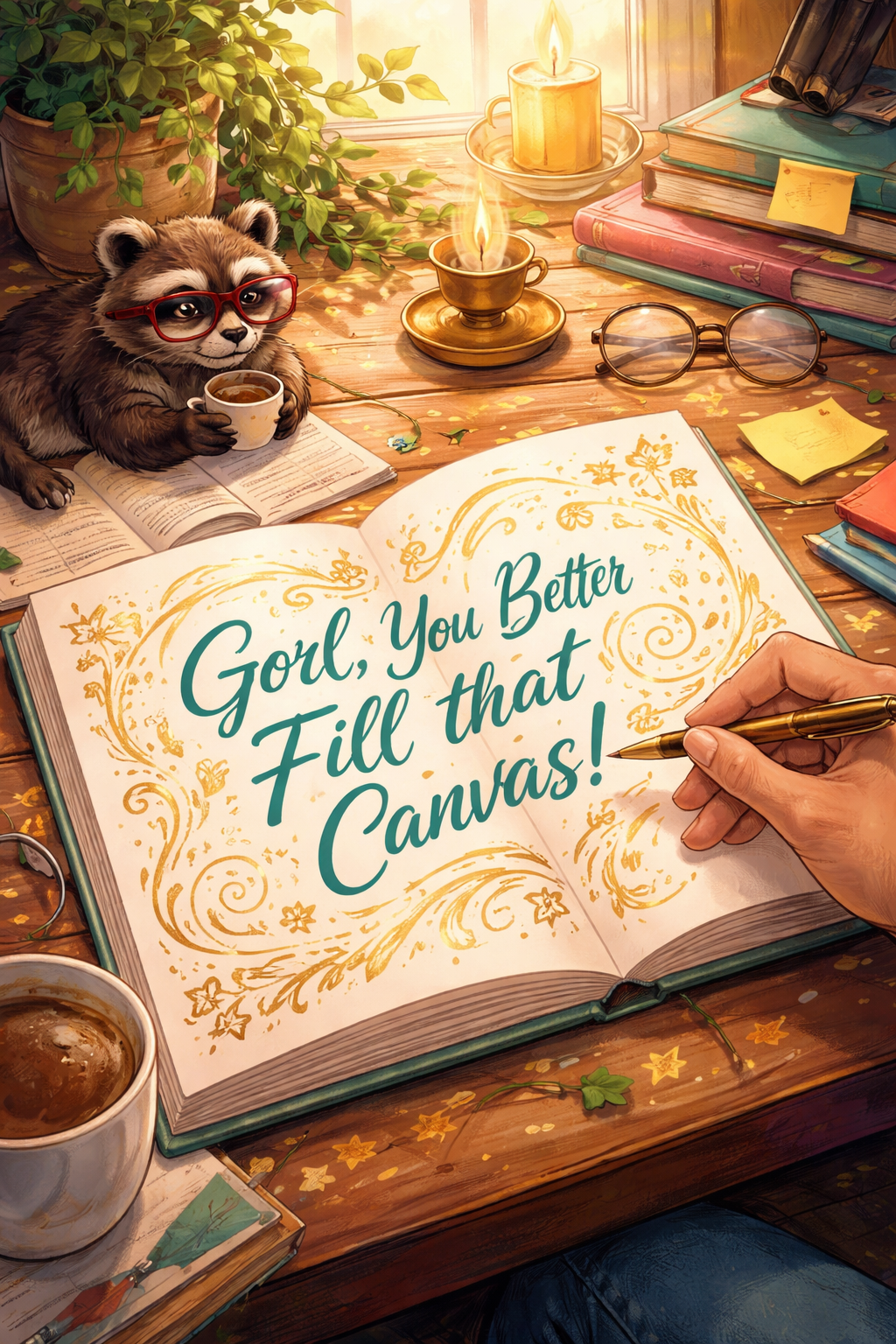
Now I’m asking myself what so much white space is sacrificing. And what could I DO with it! Word Raccoon is practically swooning at the idea. Why, she could create word sketches and tableaux. She could let the cast of the sky, or a chair tilted toward the street, a bag with a notebook half in, half out, say something that the dialogue doesn’t. Or, it could contradict it.
I notice these things all the time. Probably more than people like, I fear. I mean, my poetry is built on noticing. But when it comes to novel writing, I don’t always trust myself to know what details are important. I just know how exhausting it is to feel myself in a storm of details that don’t give me anything but seasickness when I read.
I don’t want to write longer passages about setting unless it serves the novel. I don’t want to slow everything down or pad out the prose so it looks more serious. That feels like putting on someone else’s coat and pretending it fits.
But I am interested in the idea that the world of a scene might carry a little of the truth alongside the people in it. Probably more than a little.
It could be fun.
Word Raccoon is growling, uncertain now.
Slow down, WR. No one is taking anything away from you. You’re still in charge of the poetry.
But in my mind, I’m adding gold curlicues of language to my margins, and it’s gorgeous.
Gorl, you better fill that canvas! That’s what it’s there for.
Now if you will pardon me and Word Raccoon, we are going to go make Dutch oven lentils. We have discovered there are 5 bags hiding in the cupboards, both brown and red, as well as various potatoes sprouting and half an onion that hasn’t been paying rent in the fridge but probably should. It’s “clean those winter cupboards out” season.
(I’ve never tried a lentil loaf. Should I give it a go?)
Let’s not talk about how many bottles of salad dressing I found. And I thought I had just finished the last bottle. Sigh. (I make my own sometimes, too, of course.)
Out of sight, out of mind. It’s a curse.
 dremadrudge.com