Word Raccoon and I are still reading Emily Dickinson. Not according to plan, no, no, of course not, because my puppet of chaos could not allow that, but we are reading.
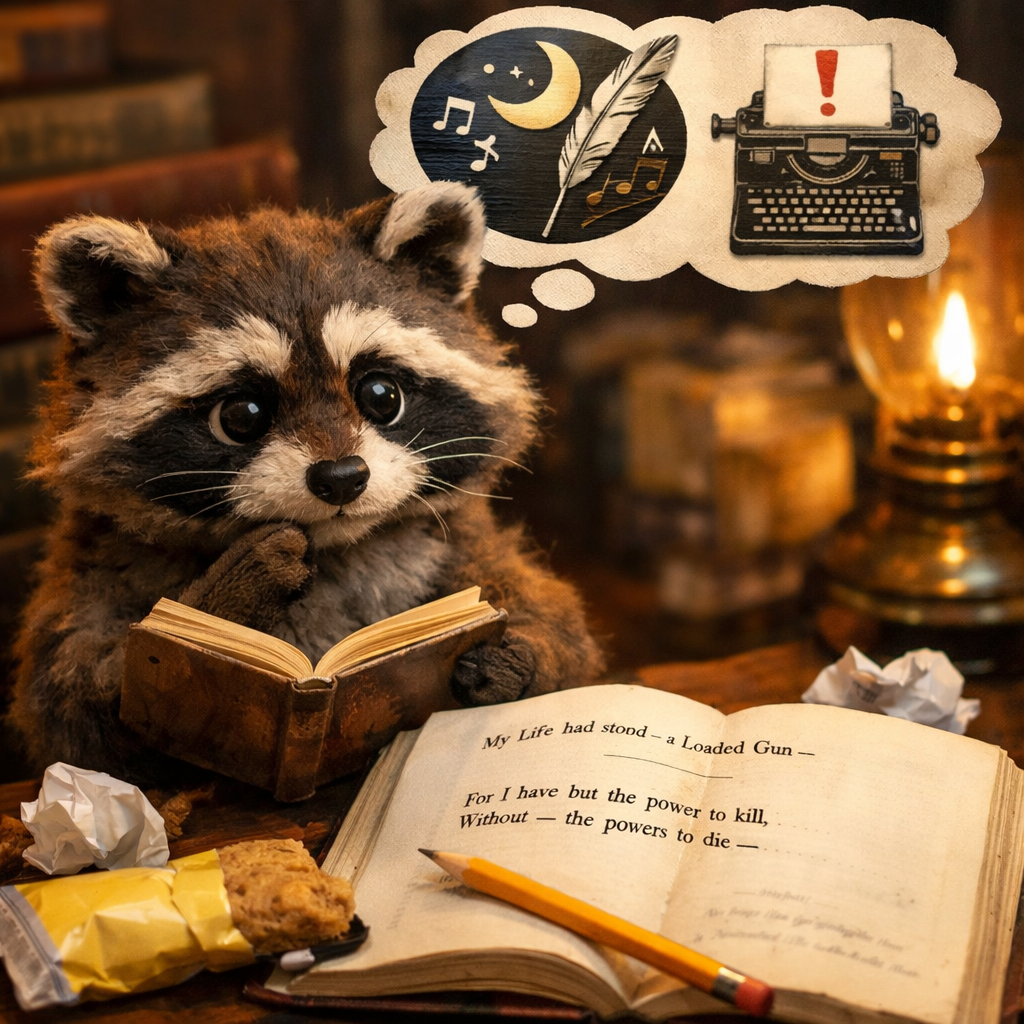
Yesterday I caught myself rereading the end of “My Life had stood – a Loaded Gun –,” which, if you’re familiar with the poem, ends with a paradox that refuses to smooth its hair.
And if you’re not familiar with it, I recommend this power-packed poem.
The “power” in the poem is tangled with dependence and agency. The tension holds at the end like I hold onto the handle of the rare roller coaster ride I allow myself. (Word Raccoon would go on more roller coasters if I’d allow it.) It’s quite the ride.
My novelist brain says about the poem at its end: Close the damn scene. Take the shot.
To novelists, a scene must justify its existence. Even if the ending is ambiguous, it is shaped ambiguity. Something has shifted. A door closes. A line lands. Action has occurred or is implied.
In fiction, you do not (usually; exceptions to every rule and all that) get to simply intensify and walk away. You don’t toss a match and hope something blazes. The reader must feel the emotional circuit complete.
Dickinson does…something different.
She cranks up the volume and then leaves the room with her middle finger raised without looking behind her.
The poem does not close like a scene. It reverberates like a song on repeat.
Word Raccoon, who prefers either a tidy ending or a dramatic explosion (because of course she does), would like to know where the rest of the story went in the poem.
Dickinson shrugs, which is kinda maddening and kinda brilliant.
CRAFT NOTE INCOMING, THOUGH NOT CAREFULLY EXPLORED:
Narrative logic asks: What happens next? What does this mean for the characters?
Lyric logic asks: What is the exact texture of this moment? What will destabilize the reader enough to make them return to the poem?
Dickinson is not trying to finish a story. She’s allowing the tangle in the curl to remain, knowing if she combs it, the tangle leaves but so does the curl. (Ask me how I know.)
The person in the poem (she used many personae; let’s not assume she always meant herself) has to grapple with agency and dependence, no small things. Whether we read this as poet and muse, woman and her relationship to a man, or so on, none of these scenarios are easily resolved. Asking her to do so by the poem’s end is asking her to tidy life.
We all know that’s no easy task.
If this were a casual essay, that would be the end of my post. But as Word Raccoon has pivoted from my structured Dickinson study plan (naturally) into poetry-as-she-pleases with tasty snacks, I will allow myself a pivot as well.
When I stand before a painting I do not fully understand, I might admire the color, the composition, the boldness of the gesture, the way a painter defies expectation. I do not demand that every brushstroke translate itself into a thesis statement.
(Usually. Unless I feel like the artist is trying to say something and I’m missing it. But in general, I have learned to relax and enjoy art without having to study it for meaning.)
I might even, gasp, just enjoy the beauty of a pink stripe or a buzz of sunlight.
But when I read a poem or a novel, anything, I expect total comprehension.
Line by line.
Word by word.
Punctuation mark by punctuation mark.
If I cannot explain it, I feel I have failed.
I know that’s expecting a lot of myself. I know that’s impossible. Even if I look up a word I don’t know, sometimes that’s not enough because the usage is archaic or feels misplaced or, you know, poets take that thing called poetic license.
Sometimes it’s the feeling the poet wants for us, not total comprehension. Maybe they are gesturing to the incomprehensible.
Sometimes they are purposely obfuscating.
When I was a child, there were moments when the older women at family gatherings: my aunties, my mom, my grandma, etc., told stories I don’t think I was always supposed to understand.
Often, if I stayed quiet and out of sight, they seemed to forget I was there and would say the things that would then make sense of something I had only half comprehended until then.
Or that would make me ask a question that would quiet the car on the ride home.
If I made any sound or made myself too visible, my grandmother would tell me to “run off and play,” which maddened me. I wanted to hear the stories, even the ones about the aunt who had surgery and the gruesome aftereffects.
I also delighted in just listening to my relatives’ rich Southern voices, something I was still keenly aware of because our family had recently moved to West Virginia from New Jersey. (My parents had been born in WV and were returning there; I had been born while they lived in NJ.)
When I did go outside to where my dad and the other men were, their stories were often about work: the guy who brought six boiled eggs every day for lunch, coal mine cave-ins and who had gone on disability as a result, a joke about the best way to patch a henhouse. Those tales were just as captivating, but these also relied on translation. I knew not to ask questions, not there, to once again be quiet and listen.
Especially when I could tell that the nervous laughter around “henhouse” meant I was missing something they were afraid I had picked up on.
So when Dickinson compresses meaning and leaves it partially veiled, I want her to say it plainly. I want the sentence to behave like a sentence and not a riddle. Word Raccoon would like to file a formal complaint with the Department of Declarative Statements against some poets.
But perhaps the tangle is not evasion. Perhaps it is, as I said above, honesty.
Truth be told, I like a literary challenge. I just want to feel that if I keep trying, success is possible. Cracking literary code is my quest movie. To say there is no code is to take away my joy in literature.
That’s probably a shortcoming.
WR is swinging from a curtain rod, nodding and nibbling on a lemon Luna bar.
A novelist closes scenes because narrative demands movement and consequence. A poet may leave the door open because experience itself is unresolved and/or unresolvable.
Dickinson is not careless. She is precise in her refusal to simplify. Even WR admits that.
And maybe part of my own education as a poet is learning when not to close the scene.
To let the voltage remain.
To trust that a reader can stand in the room without the lights being fully explained.
Word Raccoon is unconvinced, but she is willing to consider it. For now.
If her poem from yesterday is any indication, she may even be embracing it.
 dremadrudge.com