No one anywhere asked for another poem about flowers.
But today I fell into an Emily Dickinson vein and, unfortunately, it was not the kind of vein that politely delivers a single respectable poem and then returns you to normal life.
No.
It was the kind that sends you into the metaphorical woods with a clipboard and a moral dilemma.
This started because I was listening to Maria Popova’s work, The Universe in Verse: 15 Portals to Wonder Through Science & Poetry. (It’s a wonder!! My brain: afire!!)
And she mentioned Emily Dickinson’s herbarium, the one with 424 wildflowers pressed into paper. (A full-color printed edition exists, but it’s out of print now and costs HUNDREDS of dollars.But guess what? It’s accessible online FOR FREE!)
https://iiif.lib.harvard.edu/manifests/view/drs:4184689$40i
Anyhow, Maria Popova said it might’ve been Emily’s first poem.
And I, a person who has absolutely never overreacted in my life, (cough, cough) thought:
YES. THAT’S IT. THAT’S THE WHOLE THING.
Because a herbarium is not just a cute science project for school.
A herbarium is:
- devotion
- control
- love
- theft
- preservation
- and just a hint of Victorian menace
Flowers stolen from the world and flattened into eternity.
Which is, if we’re being honest, very similar to how poetry works.
I was already in a tender, literary, spiritually flammable state from the collection.
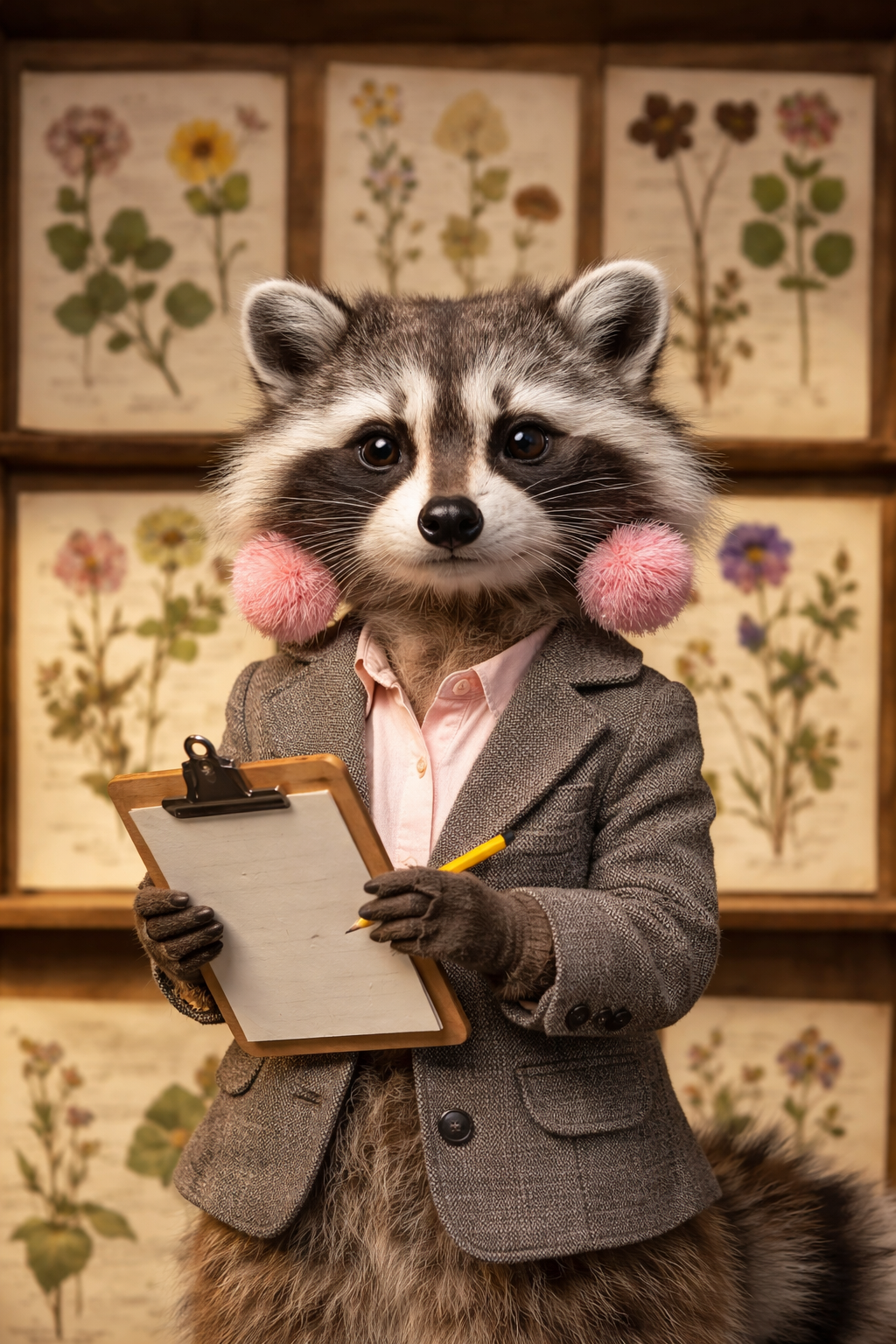
Enter: Word Raccoon.
Word Raccoon detected “Emily Dickinson” and “flowers” and immediately transformed into the worst kind of museum visitor.
Word Raccoon stood at the threshold of the herbarium and said:
EXCUSE ME.
HELLO.
YES, I HAVE QUESTIONS.
Word Raccoon would like you to know she does not simply look at historical artifacts. She interrogates them.
Word Raccoon looked at Emily Dickinson’s herbarium online and said:
Hi. I’m calling about the pressed violets.
I would like to speak to whoever is in charge of this entire situation.
I said, Word Raccoon, no one is in charge of this situation.
Word Raccoon said:
THAT IS WHAT I SUSPECTED.
AND IT IS UNACCEPTABLE.
Word Raccoon opened a tiny notebook and began jotting down “complaints.”
Complaint #1: Why so many flowers??
424 wildflowers is not a collection.
424 wildflowers is a floral hostage situation.
Complaint #2: Violence??
Word Raccoon said:
So Emily just beheaded them and pressed them into paper?
We’re calling this “botany”?
Ma’am.
Complaint #3: Labeling
Word Raccoon got extremely agitated about the labeling.
She wrote the names of the flowers.
She labeled them.
THIS IS A DOCUMENTARY LEVEL OF ACCOUNTABILITY.
Then Word Raccoon discovered some specimens weren’t labeled and became furious in a very specific way:
Not all of them??
NOT ALL OF THEM??
So we’re just leaving some flowers unidentified like a cold case file??
Word Raccoon demanded I open a case.
I said, Word Raccoon, we are not reopening Emily Dickinson’s botany cold cases.
Word Raccoon said:
THEN WHY DID SHE BRING US HERE.
At this point, Word Raccoon attempted to call Nature.
I said, Nature does not have a phone.
Word Raccoon said:
THEN HOW DO WE ESCALATE THIS.
So I did the only reasonable thing.
I wrote poems.
A ridiculous number of poems.
Here are some of today’s botanical incidents:
- 424 Wildflowers
- Herbarium, circa 1839–1846
- Speciwomen
- Is it Growing Yet?
- Ask One True Question
- Violets of the Eyes
- No One, Nowhere
- Trillium in a Green Jacket
- Jack-in-the-Pulpit
At some point, Word Raccoon became convinced this was a corporate situation and began speaking in “professional voice.”
Word Raccoon said:
Emily Dickinson, thank you for reaching out.
We have received your request for eternity.
Our current processing time is 1830–1886.
I said, Word Raccoon, stop.
Word Raccoon said:
HAVE YOU OR HAVE YOU NOT BEEN RESURRECTED BY SNOW, DREMA.
And I couldn’t even argue, because the truth is: nature does resurrect people sometimes. Not literally. But yes literally (sort of).
The way snow hushes the world and how some people remind you to use your senses, always.
The way violets shout anyway.
The way a flower reminds you you still have senses, even when they’re pressed. (Take that however you’d like.)
The way a pressed specimen (speciwomen?) can become a poem, and a poem can become proof you were here.
So yes.
I sat by the window watching the snow fall and wrote and was just grateful that the poem had more fire than Monday’s which were fine but felt like throat clearing, even if the kind barista turned on jazz for me to write to as he read On the Road for the first time.
MEANWHILE…
Yesterday was only writing on the novel and WR licked a finger and flipped through all the magazines at the library (Gross! I did not really let her do that. But she did drink all the tea and eat all the cookies.) waiting for me to finish up. I wrote 2K words, so go, me.
Today, WR told me ONE OF US WAS GOING TO WRITE POETRY AND IF I DID NOT THEN THAT THING IN MY THROAT WASN’T GOING TO GO AWAY.
AS IF IT EVER WILL.
I feel connected to Emily Dickinson.
Not because I want to become her, but because I recognize the impulse.
The need to keep what matters.
To name it.
To press it down so it doesn’t float away.
And obviously, I, too, have been known to press flowers. I recognized many in her album, even though they are mere whispers of what they were.
Word Raccoon would like to end this post with an official statement:
WE WOULD LIKE TO THANK EMILY DICKINSON FOR HER CONTRIBUTION TO THE FLORAL COMMUNITY.
HOWEVER.
WE REQUEST LESS FLOWER BEHEADING MOVING FORWARD.
I mostly agree with WR, but she could stop shouting. Because, for one thing, it’s a little late.
And also, I’m lowkey obsessed with the flowers.
I would like to end with this:
The short violets shout.
Pressed, not bowed.
And if you need me, I’ll be trying to do normal life things while Word Raccoon files a formal complaint against Spring.
And submitting poetry. To seven places so far tonight.
 dremadrudge.com