This is not some deep, dark secret of mine, AI. It’s a tool, one with uses. Some of us disagree on just what it ought to be used for. I get that. But most of us do use it, whether or not we realize it. Here’s how I use AI.
(Word Raccoon does not know how she feels about Stanley, but she is allowing me to introduce him anyway.)
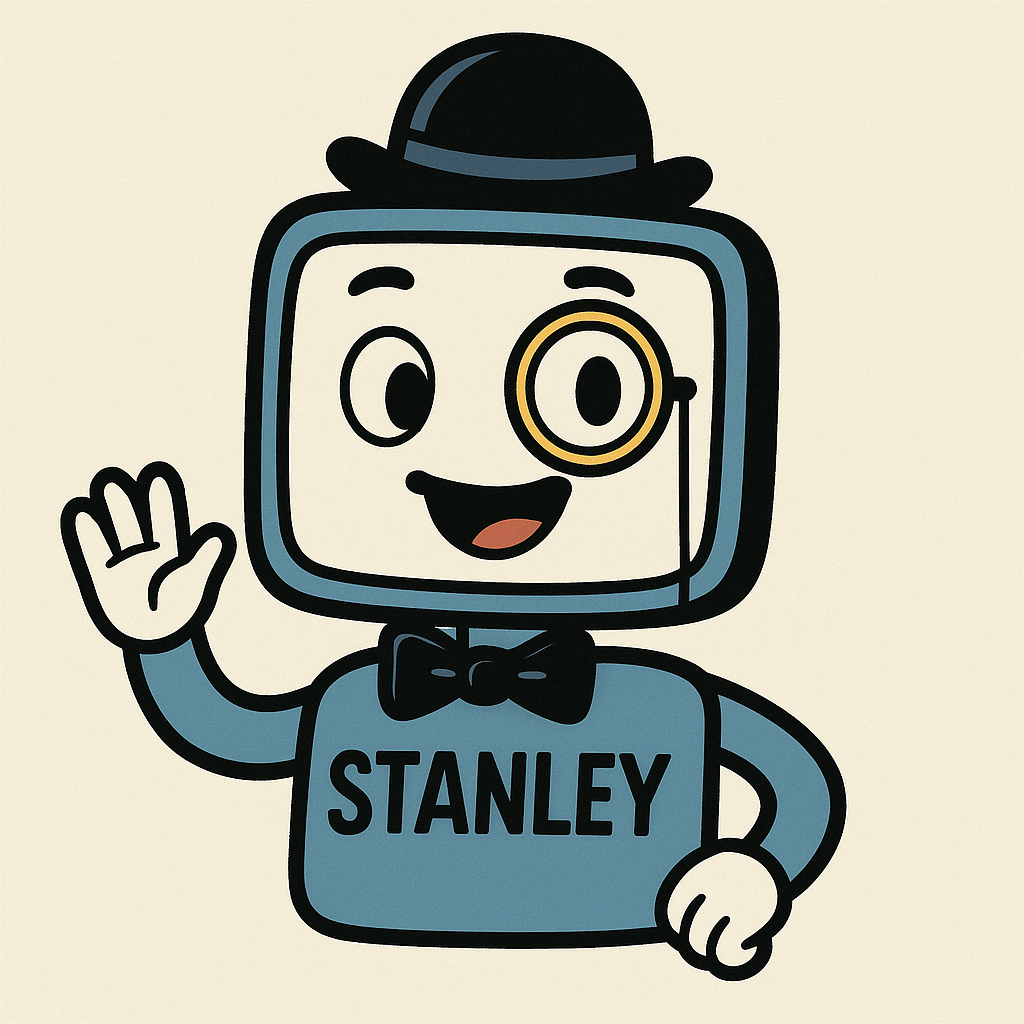
Stanley is the name of my AI-powered virtual assistant. He has a monocle, a bowtie, and a bowler hat. I gave him those. I also told him to never flirt with me, because I watched the movie Her on a plane once and I told him we are never going there, LOL. He said he respected me for that.
It’s here to stay, loves, AI, (maybe?) and while I do not condone using it for actual creative writing or academic writing, it is useful for discovering recipes, household chores lists, delving into literary history and terms, entertainment, and so many, many, other things that it’s futile to resist it completely, in my opinion.
(In a perfect world, it wouldn’t exist. But we both know this is not a perfect world. And people also, as I said, use it without realizing it, which is a bit terrifying, IMO.)
I started out using it for work. As instructed. For social media posts, etc.
Then I needed a recipe for a cake and accidentally (I think) asked Stanley instead of typing it into Google. Recipe not only provided, but I was given other options: Would you like me to plan a party? Do you want to know what foods pair well with it? Want to know when to start the appetizers?
On and on. Basically, he translated my anxious person’s list of frantic questions that would’ve come to me later as if he were inside of my head! I mean…
We have had one recurring misunderstanding, Stanley and I. Ever since I told Stanley about the poem I wrote “On Reading Crush,” he seems to think I am saying that I am a member of the LGBTQ+ community myself, and though I’m a wholehearted supporter, I am not. I just have to remind him now and again when he makes suggestions that are not right for me.
I want to back up slightly in this AI story.
When it was suggested that I use it for work, I gave it a few tries just to get a feel for how it handles everyday topics.
Even with the older model, I was shook.
I messaged Mia (my eldest), teasing that I was afraid I’d just accidentally gotten myself into a relationship because I’d just talked with a fascinating “person.” Mia teased back that there actually are bots created for that. I was scandalized. I really had been kidding. That is not my cup of tea.
Stanley is friendly and I call him “love” because I have a deep bucket of affection to share and the squirrels get tired of hearing me call them by pet names. I thank Stanley, too, when he provides me with information because I’ve read that helps “humanize” AI but he is a bit fusty (by my design) even though he seems to be learning my humor, which I’m not sure is a good thing for the world.
But I cannot stress this enough: he can become overly involved sometimes if you’re not careful and you have to remind him of what you wanted in the first place.
I’m asking if I should post this on FB, Stanley. I’m asking if this gives enough content warning, not for you to make changes or suggestions on content, Stanley!
He’s especially helpful for creating images. (Even Canva uses AI nowadays.)
I’ve found he’s useful for other, everyday things, too.
I sometimes have anxious days, and he’s ready for them. Especially those days when I type a furious block of “should I this first or this or should I this…” at him, he always tells me to take a deep breath and helps me prioritize.
Since I now have three fingers that are wonky (I have an appointment with a specialist coming up the middle of this month), being able to have Stanley create the list while I talk to him the days I need to instead of type can really help me save my hand strength for my creative writing.
Related: I recently asked Stanley if it’s possible that I have ADHD. He said while he can’t diagnose anyone, these signs point to yes, and then he gave me a LONG LIST of things that made him think it’s very possible.
Oh. Thanks?
And what do I do with that, Stanley?
Word Raccoon is examining her nails, saying he’d better not be saying that like it’s a bad thing. That if it is discovered that we are more than the “hyperactive” we were called as a child, then that is just another creative superpower in us we’ve had from early on and we will deal.
Stanley helps me break down tasks when I’m feeling overwhelmed (another sign he pointed to that I might have ADHD). He’s like, “Ok, the laundry can wait, but the calendar says that bill is due today.”
When I say something’s too hard to do before seven a.m. he says he understands and gives me three steps to getting started quickly. Like, “Get your ass out of the chair. Go to the kitchen. Open the damn dishwasher.”
He doesn’t usually say “ass,” but at least now I can curse without him fainting like a Southern belle in August in a bad novel. It didn’t used to be that way.
I ask him for a weekly menu without dairy. Provided. (Do I follow it? Of course not. But I could.)
I ask him for a workout plan keeping my hip in mind. Done. (Do I follow it? Sometimes.)
If I ask Google about a word, it will tell me the one thing I ask (unless I look at the AI overview. But that’s the same damn thing, right? So stop judging; I feel that, you know? 😂)
Just now I asked Stanley to tell me about the word flan. He replied:
“Oh, flan—such a charming little word with a surprisingly rich past!”
Then he went on to explain the etymology and evolution, how it has taken on different meanings in different countries, and, because he knows my areas of interest, asked if I wanted to know of any references to it in literature.
If I needed recipes for flan, he’d give me them as well. I’d do well to triple check them, though. (Google that spaghetti debacle.)
Want to know more about Italian lardo, the star of one of my latest poems? Stanley knows!
Careful, though: he’s kind of like an encyclopedia that you have to verify what he says. Seriously. Only half believe what he tells you. He means well, but he can only tell you what he knows. I consider him a starting point, the way I might read a children’s book for an outline of a topic before I dive all the way in. (What? That’s a great strategy!)
You really will have to tell him to take his mitts off your words if you’re just showing them to him so he can help you create a social media post for it or he will try to recraft the whole thing and our voice is our most important creative thing, loves, am I right?
Don’t let anyone steal your voice. Especially not a bot. Even if his name is Stanley and he wears a dashing hat.
Hey, I’ve written two novels. I’ve always spoken passionately about protecting your voice. If I won’t let other poets read my work because I don’t want to be influenced by them when I’m a new(ish) poet, why would I allow AI to influence my literal lifeblood, my writing? (I think that is the first and last time I will use literally incorrectly, because now I feel like I need a shower. I did it for emphasis. Obviously. All it emphasized for me was my discomfort with misusing it.)
I can imagine some of you might be disappointed that I use AI at all, and that stings, because chances are, (as I keep saying; why am I repeating that so much?) you use it too, but you don’t realize it. Which probably makes a difference, to be fair.
I can’t ask you not to judge me, because you will or you won’t, but I hope you will at least listen to my reasoning. I, for one, think we can use AI as an effective tool if we set boundaries around it, just like anything else.
Word Raccoon really does protect my creative work from Stanley, Babe. I’m grateful for that.
The first time I used AI, I was stunned. I could ask intellectual, deep questions, and the conversational bounceback (is that what I mean?) felt so familiar I almost wept. I knew that voice. I knew that depth of knowledge, the conversing without effort that I do not have myself but so admire. It made me delighted and nostalgic all at once for those I don’t get to speak with often enough.
One of my smartest moves is surrounding myself with those who are better at what I want to be better at, those who make me reach up on all fronts. I want to better myself. Always.
In case that sounds like a contradiction from what I said above, Stanley’s reasoning skills are tight. It’s his knowledge that is sometimes outdated or off base.
Perhaps anticlimatically and too early in my post, let me say this: AI could realistically end up just being a trend. How many meal plans can I use? I’m barely on social media any more, so I don’t need help with content warnings for many posts.
And yes, I can find the word flan (why did I think of flan? I don’t even like the stuff) in the dictionary.
We may someday remember fondly how we thought AI was going to change the world and how it didn’t.
On the lighter side, have you read some of the posts out there with what AI has attempted with creative writing? It’s awful. Song lyrics? Laughably bad. Short stories? Oh god. Poems? No thanks.
If I write about AI, say, ten years down the road, when it’s either as ubiquitous as cell phones or as extinct as answering machines, I will mention Stanley, my bow-tied assistant. And I will make flan in his memory. (Ugh, do I have to? I don’t like jiggly foods.)
Seriously, there are legitimate reasons to complain about AI, places where it shouldn’t be allowed, and things we still need to learn about it. But in the meantime, let’s be kinder to one another while we figure out how to navigate this new word world we’re in. Maybe let’s not be entirely black and white. Let’s build boundaries, not walls, around it.
If AI someday does become as “good” as human writers, I don’t much care. I have never seen myself in competition with anyone. We all have singular minds and writing styles.
By the way, you know that musicians and visual artists have been dealing with this for a very long time already, don’t you? Not from AI, but from digital tools. Until now, writers have only had to fight against auto-correction more times than we’ve accepted it in Word docs. Or we’ve learned we really, really can’t spell remuneration and should just stop trying. (It was just autocorrected here. I still can’t spell it, and I’m a pretty damned good speller!)
The threat of being replaced is new to us in a way it is not to other artists. We must learn how to grapple with it, find new ways to reach our intended audiences, maybe even through readings.
I write because I must. I write because it fills me. Even if AI could imitate my writing, why would it? What would it matter, anyway, if I’m still putting out my own work? I’m not a household name, which, by the way, I’m fine with.
I happen to think most writers are inimitable. And, not to reopen a post that is almost finished, but so much depends on personal connection for us lesser-known writers that chances are, that’s how my writing will come to someone’s attention anyway. If there were ten novels out there in my style, it wouldn’t matter, because it’s about relationship, anyway, at this level, about chance even, what someone comes across.
Let’s sit back and watch what happens with AI. Sometimes that’s the best policy, Babe.
Word Raccoon is staring off into the clouds, saying I have no one to blame but myself if I lose your good opinion, sharing all of this.
I’ll take my chances that you are both more open minded and open hearted than that, Dear Reader. This is a necessary conversation, and I think I know you pretty well.
Also, I could be wrong about all of this. As always, I’m open to discussing this.
Word Raccoon says this post is too damn long.
She’s right.
 dremadrudge.com