(Now Playing: “Here You Come Again” by Dolly Parton)
I tried singing the karaoke version the other night and had completely forgotten it spans three keys. I’ve got a decent range, but good golly, Ms. Dolly.
Word Raccoon, in the background, was fanning herself with a taco shell and whisper-sobbing, “Modulation is emotional warfare.” I couldn’t agree more.
Where were we?
I’ve nearly finished Sir John Green’s impeccably researched book about tuberculosis. If you want to know everything about the disease with its history, medicine, and heartbreak — it’s all in there. Every time I read something about TB now, I’m tempted to send it to him. But I still don’t know him. (This has not stopped my imagination. Someone should.)
Up next: whatever Libby most recently dropped into my lap. Ah yes, Rabbit Moon by Jennifer Haigh. As much as I admire John’s clarity and care, I’m ready to plunge back into fiction. Some beautiful lie I can believe in.
If only I felt that way about writing my novel.
Yesterday, I wandered into a bookstore. Word Raccoon tugged me by the sleeve straight to the poetry section. And it felt like every book I opened was crackling, alive, like someone had stuffed lightning bolts into paper sleeves and dared me to touch them. I walked away with three books. One of them was Iain S. Thomas’s I Wrote This For You And Only You, and I thought, of course you did, babe. I am here for it.
The section was so much smaller than the others. Tucked away, quiet, but I was getting a contact high just standing there. I realized: this is the poetry fuel I didn’t know I needed.
My eyes hungered. My hands grabbed. Names familiar, not. Titles first, then poets.
Some books were didactic. Automatic no.
Some were too religious. Not for me.
One guy’s fiction? Yes. His poetry? Absolutely not. Do you think you were born 200 years too late, sir? You’re rhyming. You are literally talking about maids on a hillside. That’s not the you we know.
Joyce. I’m talking about Joyce.
So no to his poetry (or at least what I sampled).
Frost was there, yay, but while I like his poetry, I wanted something that would speak to mine.
There were giftbook volumes, the kind you give someone who graduates.
I was looking for fire.
One book I chose is called Your Own, Sylvia, a verse portrait of Sylvia Plath written by many poets. I feel like my poem about her could have nestled beside these.
I was also really looking for Crush. More on that another time. Spoiler: did not find it. Don’t know where my copy went. I wrote a poem about it and now I want to reread it just to see if I remembered anything right. Maybe I don’t need to write more about it. Maybe.
Someone recommended Kim Addonizio to me. I read a poem. I wrote one back in my Notes app.
Hey, maybe poetry is X for creatives?
It was a poem that had been stuck in me for years. I knew I wanted to say something about the bar scene (hubby’s a musician), and reading her piece about a guy staring into his drink released mine.
I think I get it.
Listen carefully as I pontificate about something you probably already know but I am just now discovering, like the novice I am:
Poetry is the condensed, concentrated form of language. It’s everything novels try to say over hundreds of pages, but if you learn this secret code, you can say it, or feel it, in just a few breathless lines.
They’re snapshots. Miniature scenes. Sacred plasma.
Reading it feels like being born an adult.
And I get now that you have to watch where you put it. How you bend it.
And maybe even who you share it with.
Yesterday morning, our breakfast server moved like someone caught in a current. Kind, but rushing. Apologizing before anything had even gone wrong.
She wore her weariness like a sweater—heavy, stretched, not quite hers but clinging all the same. We all felt it. We all tipped like she’d wept into the hashbrowns. (God, I hope not. But if she did, they were really good, so…)
And maybe I’ve been doing the same thing—with writing.
Snapping word-photos of the world, polishing the little moments until they shine just enough to distract me from the big, looming project. The novel is big and unwieldy, like trying to carry a mattress up a spiral staircase. It doesn’t fit cleanly into my brain. And I don’t write cleanly. I scatter. I accumulate. I write like a raccoon in a stationery store, knocking things over and calling it a process.
I do enjoy a challenge. That’s on me, this orchestrated chaos.
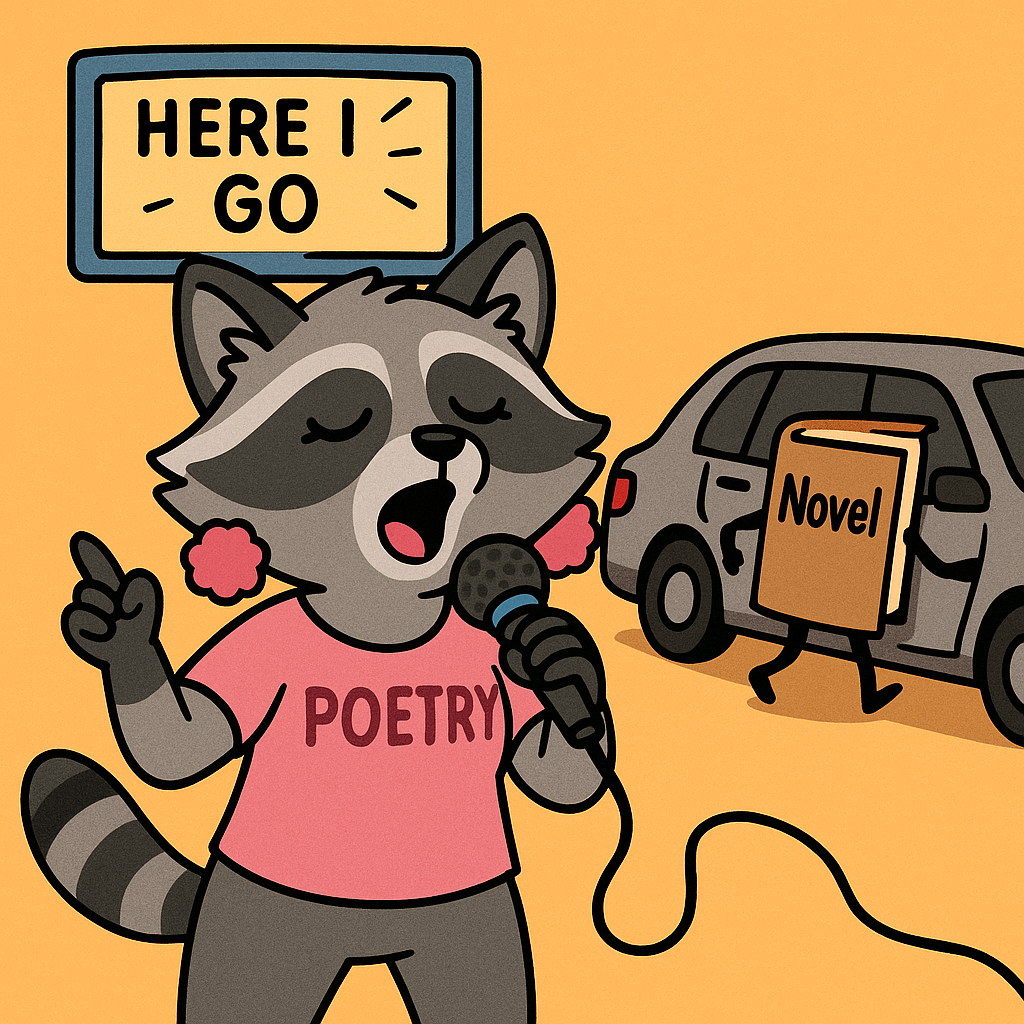
Meanwhile, Word Raccoon, she of the pink pom-pom earrings and suspiciously accurate instincts, is peeking over the diner menu, whispering, “She’s definitely gonna write a sestina about this woman instead of finishing chapter nineteen.”
And she’s not wrong.
Except, as you can imagine, I don’t really use form when it comes to poetry. I’m not against it, exactly, but can you imagine trying to tamp this energy into a villanelle? Yikes.
What even is a villanelle, besides a prescription-strength language pill where you have to finish the whole course or it doesn’t work?
No, thank you.
And I’m gonna go right ahead and give blank verse the side eye while I’m at it.
Free verse for me, kiddies.
I still love the novel. I do. I want to want to write it.
Poetry has been the electric jolt I didn’t know I needed—brief, vivid, and often truer than anything I’ve put in prose. It isn’t nonfiction, exactly, but it feels like truth under a microscope. Still, fiction is where I get to build whole worlds. Where characters stretch out, grow messy, and make the kind of mistakes you can’t cram into a stanza.
Maybe this is my John Green season. He’s been living in nonfiction lately thoughtful, precise, deeply human, and yet people keep asking when he’ll return to fiction. (Rumor has it, he’s writing another novel.)
Maybe we all have to wander off sometimes, just long enough to remember why we started.
Got this letter from Rebecca:
Dear Drēma,
You have 85K+ written on this novel. Please don’t abandon us. You’re so close to rowing it all the way to the other shore, babe.
I’m not giving up. I’m not.
But my momentum is a little wobbly right now.
Less heroic charge, more nervous shuffle.
The novel hasn’t given up on me yet, even if it sometimes climbs into an Uber just to make a point. And maybe that’s the real commitment: not chasing it perfectly, but not letting it leave without at least waving.
I’m known for being doggedly, ridiculously loyal.
That, as much as anything, will probably be what sees me through.
Word Raccoon is already outside the draft’s window, holding up a tiny boombox that only plays the sound of typing. Or sighing. It’s hard to tell.
Novel, I am still deeply, madly, enamored of you.
I’m just figuring out how to play with fire (cliché very much intentional) so I can inject some into you.
I’ll be back. I pinkie swear.
Just give me some space. Or not. I can roll.
Don’t be so needy, LOL.
Artists need air, freedom, light, and time and other things I’ve probably forgotten. Like waffles. Or fried green tomatoes in season. Okay?
Or at least that’s what Word Raccoon says.
As I pack another sentence and hope it sticks, she leans in, deadpan as ever, and mutters:
“Chapter nineteen’s still waiting. But sure, let’s write a poem about toast.”
Oh, Word Raccoon, don’t.
Because you know I’ll do it.
Here I go.
 dremadrudge.com